Coaching Sales Teams With Meeting Notes
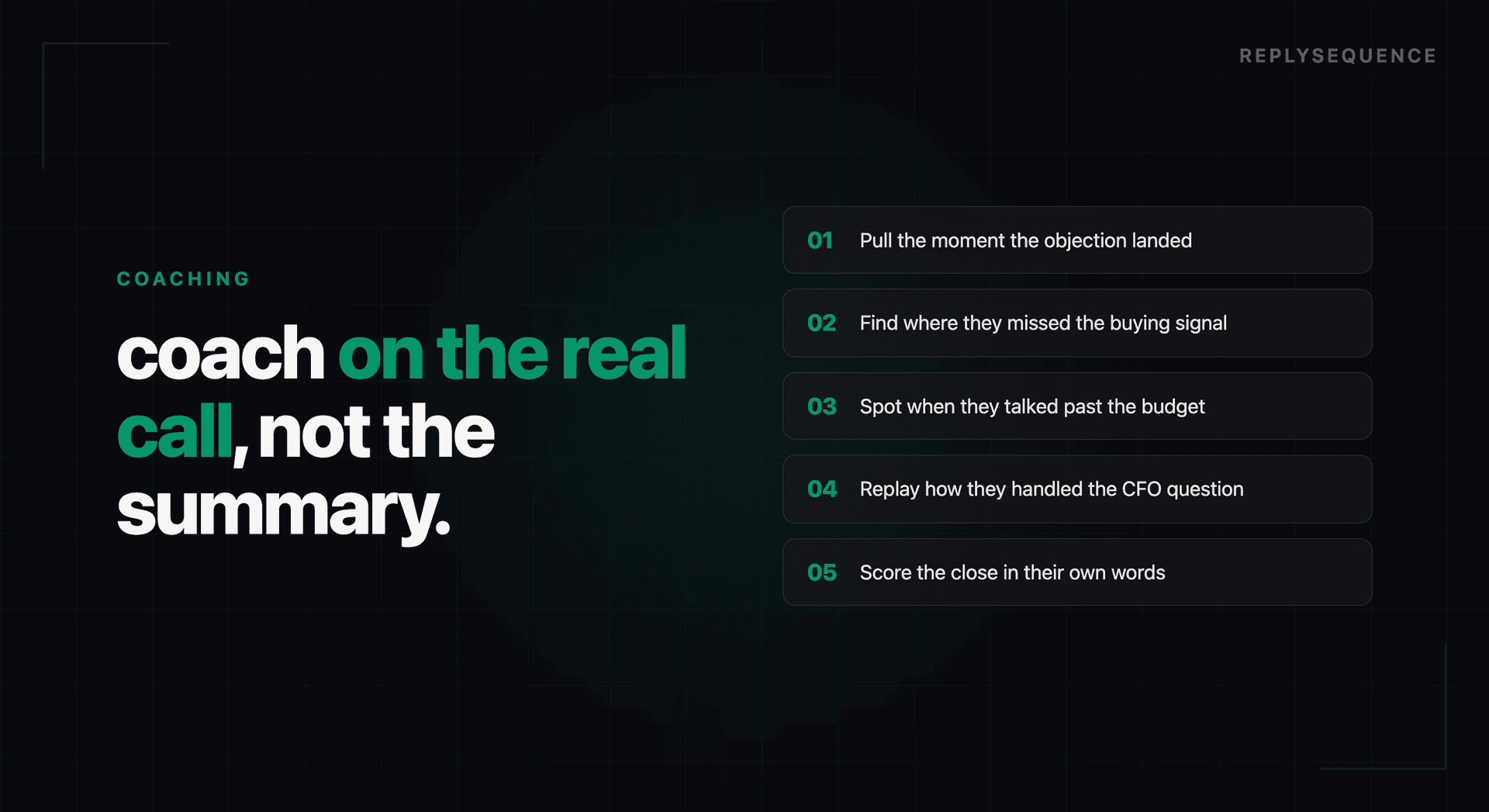
The fastest way to use meeting notes to coach your sales team on deals: pull the transcript from a call that stalled, find the moment the rep lost control of the conversation, and debrief on that specific exchange: not the whole call. That's it. That's the whole framework. Everything else is just making that process repeatable at scale.
Most sales managers don't do this. Not because they don't care: because they're drowning in pipeline reviews and the coaching just... doesn't happen. Or it happens vaguely. "Great call, but try to handle objections earlier." That's not coaching. That's commentary. Real coaching is anchored to a specific moment in a specific deal, and meeting notes (actual transcripts) are what make that possible.
Why Meeting Notes Are Your Most Underused Coaching Asset
Here's a stat that should bother you: research from Gartner shows that reps forget 70% of training content within a week of receiving it. Generic role-plays and abstract frameworks evaporate fast. What sticks is reviewing a real conversation from a real deal a rep is actively working. The stakes are live. The memory is fresh. The behavior change is concrete.
The problem is that most teams treat meeting notes as a documentation artifact, something that lives in the CRM or a Notion doc and gets referenced maybe once during a deal close. Nobody goes back and reads them for coaching. The transcript from Tuesday's discovery call just... sits there.
That's a waste. That transcript is a coaching goldmine. It's the unfiltered record of how your rep positions your product, handles objections, qualifies budget, builds rapport, and closes for next steps. Every gap in your team's skills is sitting in those transcripts right now.
Step 1: Get the Transcript in Front of You Fast
You can't coach from memory. You need the actual words.
If your team is using Fireflies, Otter, Granola, or Gong, transcripts are already being generated. The bottleneck isn't capture: it's retrieval and review. Most managers never open the transcript because there's no workflow pulling them back to it.
Here's how to fix that:
- Build a 48-hour rule. Any deal that stalls, loses momentum, or moves to a new stage gets a transcript review within 48 hours. Not a week later when the context is cold.
- Flag calls proactively. Ask reps to tag calls as "coach this" in whatever recorder they use. Takes two seconds. Removes the guesswork about what to review.
- Don't read the whole thing. Seriously. A 45-minute discovery call transcript is 6,000+ words. You're looking for 3-4 key moments: the objection handling sequence, the pricing conversation, the close for next steps. Skim to those.
The goal at this stage is just: get the right transcript, get to the right moment, fast.
Step 2: Find the Coaching Moment: Not the Coaching Summary
This is where most deal review coaching goes wrong. Managers read a transcript (or worse, just look at the CRM notes) and give feedback on the overall call. "You need to qualify budget earlier." "Your demo was too feature-heavy."
That's not wrong, but it's not precise enough to change behavior.
Instead, find the specific exchange where the deal got harder. Look for:
- The moment the prospect went quiet or gave a short answer after a long one
- The first time price or timeline came up and how the rep responded
- Where the rep asked "does that make sense?" instead of a real discovery question
- The close, specifically, did the rep actually ask for a next step with a date, or did they let it drift?
Real example from a beta user: an AE who kept losing deals at proposal. Looked at three transcripts. In all three, when the prospect said "I need to loop in my boss," the rep said "totally, let me know when you've had a chance to chat." That's it. No ask for a three-way call. No timeline. Just... handed the deal over and hoped for the best.
That's a coachable moment. Specific line, specific habit, specific fix. You can't get there from a CRM summary. You need the transcript.
Step 3: Structure the Debrief Around the Deal, Not the Rep
How you deliver the coaching matters as much as what you found. Done wrong, transcript-based coaching feels like surveillance. Done right, it feels like your manager actually paid attention to your deal and wants to help you win it.
A few principles that work:
Lead with the deal, not the behavior. Start with "Walk me through where you think this deal is right now" before you pull up the transcript. You want to know if they see what you see. If they do, the coaching conversation is collaborative. If they don't, that gap is itself a coaching point.
Show the exact line. Pull up the transcript. Read the exchange out loud or share your screen. "Here's the moment I want to talk about, right here, when they said they needed to loop in their boss." Being specific removes defensiveness. It's not about the rep's personality or instincts: it's about this sentence in this conversation.
Ask before you tell. "What were you thinking here?" Usually the rep already knows they fumbled it. They just need permission to say so and a framework for doing it differently next time.
End with a concrete alternative. Don't just identify the gap, give them the line. "Next time someone says they need to loop in their boss, try: 'That makes sense, would it be useful to get them on a quick call together so I can answer their questions directly? Even 20 minutes next week?'" Specific, repeatable, low-pressure.
This whole debrief should take 20-30 minutes max. You're not doing a full call review. You're extracting one or two coachable moments from a live deal and building a better habit in real-time.
Step 4: Close the Loop on Follow-Up
Here's where most coaching falls apart: the debrief happens, the insights evaporate, and the next email to the prospect doesn't reflect any of it.
If you coached a rep on how to re-engage a stalled deal (how to bring a champion back in, how to re-anchor value, how to ask for the meeting) that coaching needs to show up in the follow-up email that goes out after the next call. That's the behavioral proof.
This is actually one of the reasons I built ReplySequence. After a deal review coaching session, the rep needs to go back into that deal with new positioning and sharper language. If they're still writing follow-up emails from scratch 45 minutes after a call, the coaching insight gets buried under the friction of writing. The behavior you reinforced in the debrief never makes it into the actual deal communication.
When the transcript goes in and a structured follow-up comes out fast (with the right next steps, the right framing, the right ask) you can see whether the coaching landed. The email is the evidence.
Step 5: Build a Coaching Pattern Library
One debrief changes one deal. A pattern library changes the whole team.
As you do more transcript-based coaching, you'll start seeing the same moments repeat. The same objection-handling fumbles. The same pricing conversation drift. The same vague close. These aren't individual rep problems: they're team-level skill gaps.
Capture them:
- Keep a running doc of "coaching moments" pulled from real transcripts (anonymize the prospect)
- Tag them by deal stage, discovery, demo, proposal, close
- Add the recommended response or reframe for each
- Use them in team onboarding, weekly syncs, or a Slack channel where you drop one transcript clip per week
Companies that implement structured call review coaching see 30-40% faster ramp times for new reps, according to data from Chorus (now ZoomInfo). That's not from formal training programs: it's from exposure to real calls and real coaching moments.
Your best calls are already recorded. Your worst ones too. Both are teaching material.
What Good Looks Like
Here's what a mature transcript-based coaching workflow looks like in practice:
- Every stalled deal gets a transcript review within 48 hours
- Weekly 1:1s include one specific transcript moment per rep
- Coaching is tied to live deals, not hypotheticals
- Follow-up emails after coached calls are reviewed as the behavioral signal
- A team library of real transcript moments grows over time and feeds onboarding
None of this requires new software. Your team is already generating transcripts. You just need to treat them as coaching material, not documentation.
The One Thing Managers Skip
All of this works. But the single biggest mistake I see is managers coaching on the call content and never checking the follow-up.
Deals don't die on the call. They die in the silence after it. The prospect leaves the meeting with momentum and then gets a vague email three days later that buries the next step in paragraph four. Or gets nothing at all.
If you're using meeting notes to coach your sales team on deals, extend that coaching to the follow-up email. That's where the coaching either shows up in the deal or disappears into good intentions.
I built ReplySequence specifically for this gap. Great call, solid coaching, and then the follow-up email kills it anyway because the rep is back to writing from scratch. Paste your transcript from Fireflies, Otter, Granola, or wherever, get a structured follow-up drafted in 60 seconds, send it while the conversation is still warm. The coaching lands in the deal where it counts.
If you want to see how it fits into your team's workflow, check out replysequence.com. Bring your own transcript. The follow-up shouldn't be an afterthought.
Related reading
How ReplySequence handles this
ReplySequence takes any meeting transcript, paste it in from Zoom, Teams, Meet, WebEx, Fireflies, Granola, or wherever, and drafts a context-rich follow-up email in about 8 seconds. You review it, make any edits, and approve. Deal intelligence builds automatically.