Why Most Sales Follow-Ups Never Get Sent
# Why Most Sales Follow-Ups Never Get Sent
Follow-up is where deals go to die. Not because reps don't care, but because the system is broken.
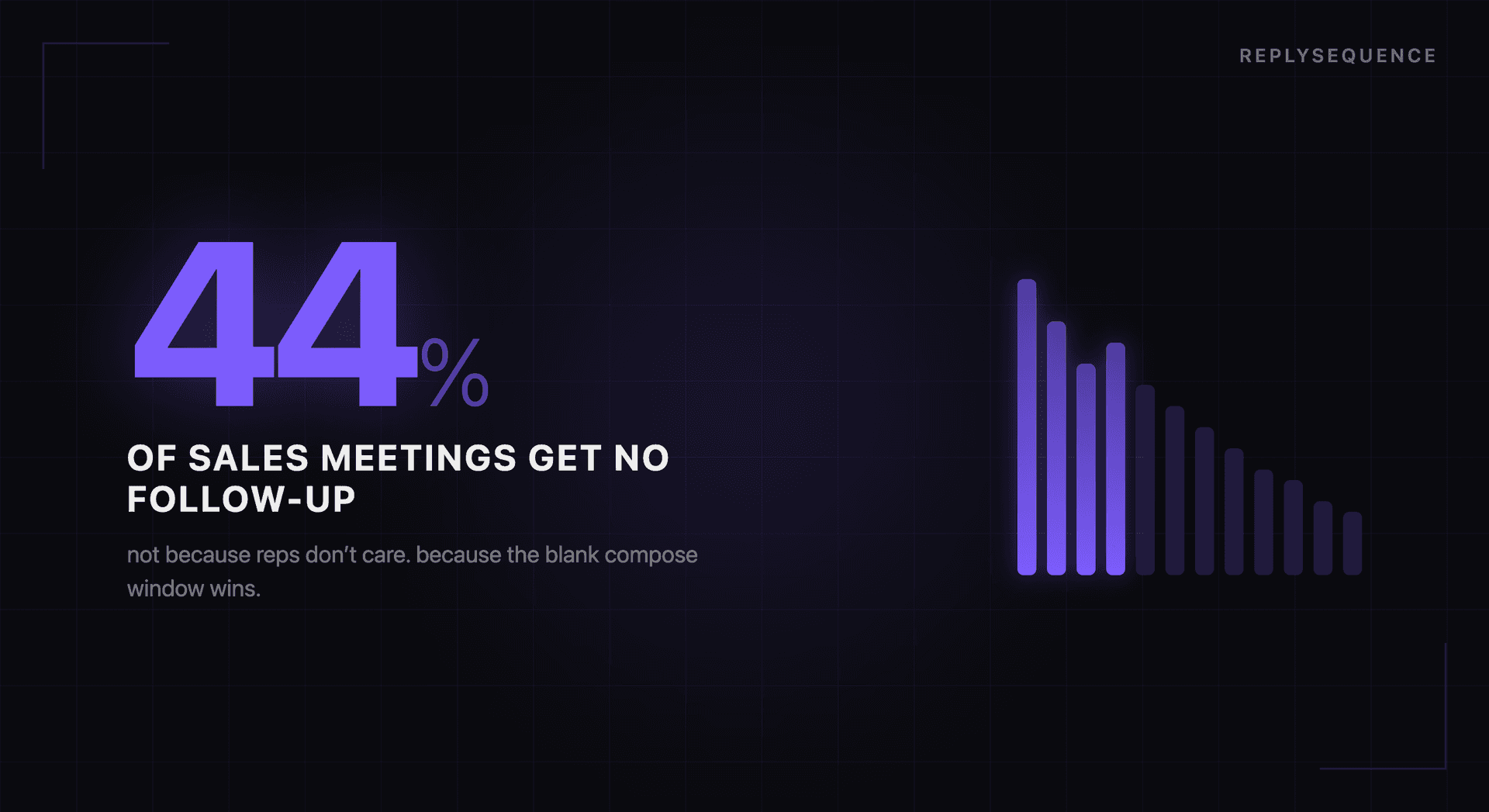
Here's a stat that should make every sales leader uncomfortable: according to research from Brevala, 48% of salespeople never make a single follow-up attempt after a meeting. Nearly half. And of the reps who do follow up, most wait more than 24 hours, long past the window where their message actually matters.
This isn't a people problem. It's a workflow problem. And until you fix the workflow, no amount of coaching or pipeline reviews will move the needle.
The Follow-Up Gap Is Costing You Revenue
Let's do some rough math. Say your team runs 50 discovery calls a week. If even 20% of those calls don't get a timely, quality follow-up, that's 10 conversations per week where the prospect heard a great pitch, felt some momentum, and then... nothing. Radio silence. The meeting went great, then nothing.
Over a quarter, that's 130 deals where the ball got dropped before it was even in play. If your average deal size is $15K and your close rate on followed-up deals is 25%, you're leaving over $480K on the table annually just from follow-ups that never happened.
These aren't lost deals in the traditional sense. Nobody said no. The prospect didn't go with a competitor. The deal just evaporated because nobody closed the loop.
Why Reps Don't Follow Up (It's Not What You Think)
The easy answer is "they're lazy" or "they don't care." That's almost never true. Talk to the reps who skip follow-ups and you'll hear the same things:
They're juggling too many conversations. A mid-market AE might run 4-6 calls a day. By the time they finish their last call, the first three are a blur. Writing a specific, relevant follow-up for each one requires recalling details they've already half-forgotten.
They don't know what to say. Surprisingly common. Reps know the call went well but freeze when it's time to translate that into an email. Should they recap the conversation? Pitch again? Just say thanks? The blank compose window is the enemy.
CRM admin eats their time. Reps spend roughly 72% of their week on non-selling activities, according to Salesforce's State of Sales report. By the time they've logged notes, updated deal stages, and prepped for the next call, the follow-up window has closed.
There's no system. Most orgs have playbooks for cold outreach, discovery questions, even objection handling. Almost none have a repeatable follow-up process. It's the most important touchpoint in the sales cycle and it's completely ad hoc.
The Real Problem: Manual Follow-Ups Don't Scale
Here's the uncomfortable truth, even the reps who DO follow up consistently are spending 15-20 minutes per email doing it manually. They're re-watching parts of the recording, pulling out key moments, trying to remember what the prospect said about their timeline, crafting something that sounds personal but not desperate.
That process works when you have three deals in pipeline. It falls apart at 30.
Sales follow-up automation used to mean drip sequences, pre-written emails blasted on a schedule regardless of what happened in the conversation. Reps hated them because they felt impersonal. Prospects hated them because they were impersonal. Nobody's follow-up problem was ever solved by a three-email nurture sequence that says "just circling back."
The new generation of follow-up automation is different. It starts with what actually happened in the conversation: the transcript, and generates a follow-up that references specific pain points, action items, and next steps from that particular call. It's not a template. It's a draft that knows what was said.
What Actually Fixes This
If you want follow-ups to happen consistently, you need to remove the friction. All of it. That means:
- Auto-capture the conversation. If the rep has to manually take notes, you've already lost. Record the call, transcribe it, and extract the key moments automatically.
- Generate the draft immediately. Not an hour later. Not the next morning. Within minutes of the call ending, the rep should have a ready-to-send email in their inbox that references what was actually discussed.
- Make it editable, not prescriptive. Reps need to own the email. The best system gives them a solid first draft they can tweak in 30 seconds, not a locked template they can't touch.
- Log it to CRM automatically. If the follow-up also updates the deal record with notes, action items, and next steps, you've eliminated two problems at once: the follow-up gap and the CRM data gap.
This is exactly what I'm building with ReplySequence. Your Zoom call ends, AI reads the transcript, and a personalized follow-up email draft is waiting for you before you've closed the tab. No note-taking, no blank compose window, no 24-hour delay.
Stop Losing Deals to Silence
The best reps already have systems for this. They write fast, they use templates, they follow up the same day every time. But "hope your best reps figure it out" isn't a strategy. Pipeline hygiene means making sure every conversation gets closed: not just the ones your top closer happens to remember.
If you want to see what AI-powered follow-ups look like in practice, try the demo. It takes 30 seconds and you don't need to sign up.
How ReplySequence handles this
ReplySequence takes any meeting transcript, paste it in from Zoom, Teams, Meet, WebEx, Fireflies, Granola, or wherever, and drafts a context-rich follow-up email in about 8 seconds. You review it, make any edits, and approve. Deal intelligence builds automatically.