AI Meeting Management for Sales: 2026 Buyer's Guide
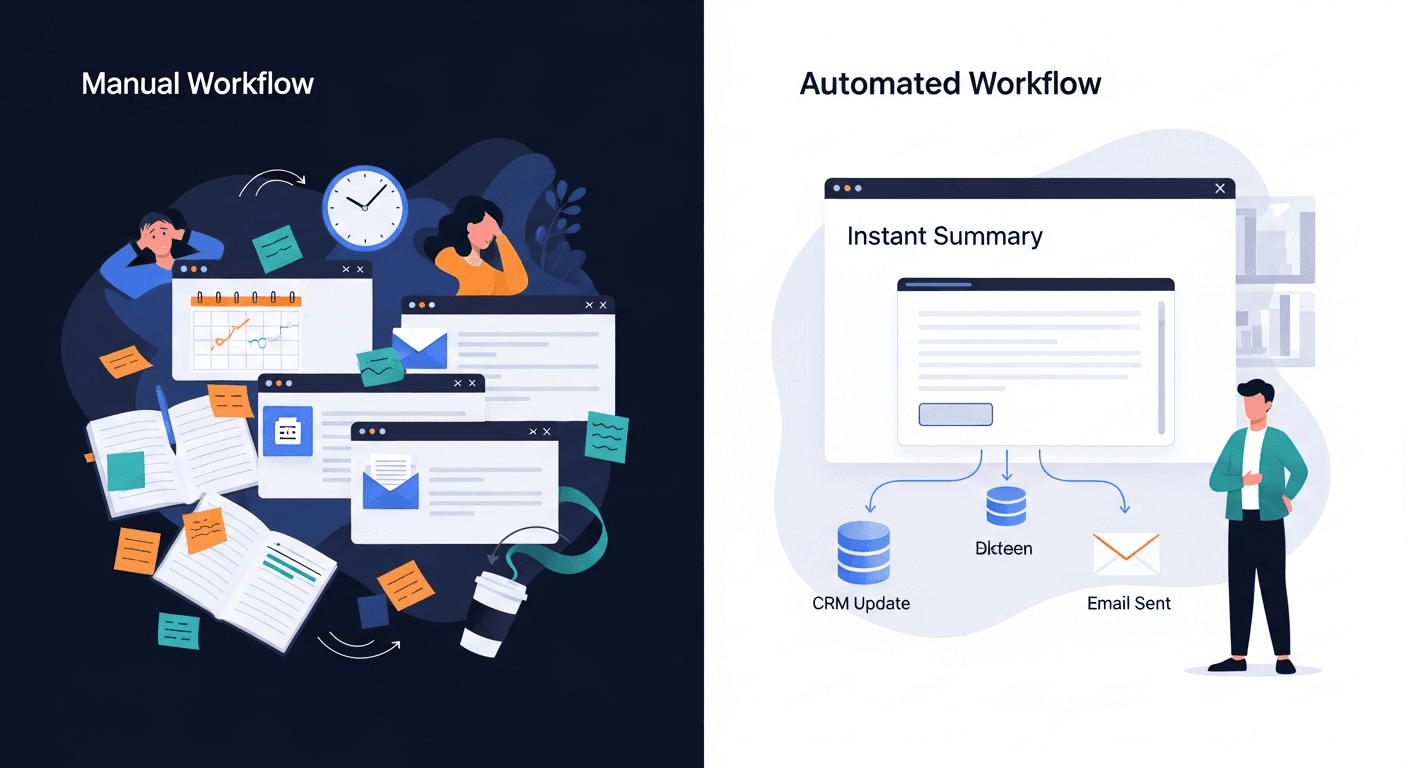
AI meeting management for sales has evolved from simple note-taking tools into sophisticated systems that automate follow-ups, sync with CRMs, and close deals faster. The best platforms now combine real-time transcription, intelligent action item extraction, and automated post-meeting workflows that keep prospects engaged without manual effort. In 2026, choosing the right AI meeting management solution means evaluating how well it integrates with your existing tech stack, handles complex sales conversations, and delivers measurable ROI through reduced admin time and increased conversion rates.
The sales meeting landscape has fundamentally changed. What once required 30-45 minutes of post-call admin work, writing summaries, updating CRM fields, drafting follow-up emails, scheduling next steps, now happens automatically within seconds. Teams using AI meeting management for sales report 67% less time spent on administrative tasks and see conversion rates improve by 23-31% due to faster, more personalized follow-ups.
This buyer's guide breaks down the leading platforms, their strengths and weaknesses, and which sales workflows they serve best.
Why AI Meeting Management Matters for Sales Teams in 2026
The traditional post-meeting workflow creates a systematic bottleneck. Sales reps finish calls, then face a choice: spend 30 minutes documenting everything properly, or rush through it and risk losing critical details. Neither option is sustainable at scale.
Modern sales meeting automation software eliminates this trade-off entirely. The technology has matured beyond basic transcription to include:
- Contextual understanding of sales conversations, distinguishing between budget discussions, objections, next steps, and relationship-building moments
- Automatic CRM updates that populate custom fields based on conversation content without manual data entry
- Intelligent follow-up generation that references specific discussion points and positions next steps naturally
- Deal risk detection that flags stalled opportunities based on conversation sentiment and commitment language
- Coaching insights extracted from successful versus unsuccessful call patterns
The ROI calculation has become straightforward. If your average sales rep conducts 15 meetings per week and spends 25 minutes on post-meeting admin per call, that's 6.25 hours weekly spent on work that AI now handles in seconds. Multiply that across a 10-person team, and you're reclaiming 62.5 hours per week for actual selling activities.
Evaluating AI Meeting Management Platforms: Key Criteria
Not all sales meeting automation software delivers the same value. When comparing platforms, focus on these differentiating factors:
Integration Depth with Your Sales Tech Stack
Transcription accuracy means nothing if the insights don't flow into your actual workflow. The best platforms offer:
- Native CRM integrations that update opportunity stages, custom fields, and activity timelines automatically
- Calendar bidirectional sync that creates follow-up tasks and schedules next meetings without switching tools
- Sales engagement platform connections that trigger sequences based on meeting outcomes
- Slack/Teams notifications that alert team members when deals need attention
Shallow integrations require manual copying and pasting, defeating the automation purpose. Deep integrations create a unified workflow where meeting intelligence flows directly into your selling process.
Post-Meeting Follow-Up Automation
This is where platforms separate into two categories: those that record and transcribe, versus those that actively move deals forward.
Post-meeting follow-up tools should handle:
- Immediate thank-you emails sent within minutes while you're still top-of-mind
- Personalized recap delivery that references specific discussion points, not generic templates
- Action item tracking with automatic reminders for both your team and prospects
- Multi-touch sequences that adapt based on prospect engagement with previous messages
- Resource sharing that delivers requested materials, case studies, or pricing automatically
Platforms that only generate meeting summaries leave the actual follow-up work to you. True automation systems execute the entire post-meeting workflow without human intervention.
AI Quality and Sales Context Awareness
Generic transcription AI struggles with sales-specific language. The difference between "They're definitely interested" and "They said they're interested but their CFO needs to approve" is massive, but basic AI misses these nuances.
Look for platforms that demonstrate:
- Sales-trained language models that understand buying signals, objections, and commitment language
- Action item intelligence that distinguishes between "I'll send you the case study" and "Can you send me the case study?"
- Sentiment analysis calibrated for B2B sales conversations, not customer support calls
- Custom vocabulary learning that adapts to your industry terminology and product names
- Multi-speaker attribution that accurately identifies who said what, critical for committee-based sales
Data Security and Compliance
Sales conversations contain sensitive competitive intelligence, pricing discussions, and confidential business information. Your AI meeting management platform needs enterprise-grade security:
- SOC 2 Type II compliance as baseline, with GDPR and CCPA adherence
- Data residency options for companies with geographic requirements
- Granular access controls that limit who can view specific meeting recordings
- Automatic PII redaction in transcripts and summaries
- Recording consent management that handles varying state and international regulations
Free or consumer-grade tools often lack these protections, creating unacceptable risk for enterprise sales organizations.
Top AI Meeting Management Platforms for Sales: 2026 Comparison
ReplySequence: Post-Meeting Automation Specialist
Best for: Teams prioritizing automated follow-up workflows and deal velocity
ReplySequence takes a different approach than transcription-focused platforms. Rather than trying to be a universal meeting tool, it specializes in the critical post-meeting window, the 24-48 hours that determine whether deals move forward or stall.
Key differentiators:
- Intelligent follow-up sequences that adapt based on prospect responses and engagement signals
- Deep CRM integration with Salesforce, HubSpot, and Pipedrive that updates deal stages based on conversation outcomes
- Context-aware messaging that references specific discussion points in follow-up emails
- Action item automation that creates tasks for internal team members and tracks prospect commitments
- Next meeting scheduling that proposes times based on discussed availability without back-and-forth
Pricing: Starting at $29/month (Pro) / $59/month (Pro+) for core automation, $99/user/month for advanced AI features
Strengths: Exceptional at moving deals forward through systematic follow-up; integrates seamlessly with existing sales workflows; strong ROI through time savings and improved conversion rates
Limitations: Focuses on post-meeting automation rather than in-meeting note-taking or real-time coaching
Ideal customer: Sales teams with 5+ reps who struggle with consistent follow-up and deal velocity, especially those using Salesforce or HubSpot as their CRM
Learn more at replysequence.com
Gong: Conversation Intelligence Platform
Best for: Enterprise teams prioritizing coaching and revenue intelligence
Gong pioneered the conversation intelligence category and remains the market leader for teams that want comprehensive analysis of every customer interaction.
Key features:
- Deal risk tracking across entire sales cycles with predictive analytics
- Coaching insights that identify what top performers do differently
- Competitive intelligence extracted from customer mentions of competitors
- Forecasting integration that ties conversation data to pipeline predictions
- Cross-team visibility into customer interactions across sales, success, and support
Pricing: Custom enterprise pricing, typically $1,200-2,000+ per user annually
Strengths: Unmatched analytics depth; powerful for sales leadership and coaching; extensive integration ecosystem
Limitations: Higher price point; focused on analysis rather than automation; steeper learning curve
Ideal customer: Enterprise B2B teams with complex sales cycles who need comprehensive conversation analytics and coaching capabilities
Chorus.ai (ZoomInfo): Integrated Conversation Intelligence
Best for: Teams already using ZoomInfo who want tightly integrated conversation data
Now part of the ZoomInfo ecosystem, Chorus combines conversation intelligence with prospecting data for a unified go-to-market approach.
Key features:
- ZoomInfo data integration that enriches meeting insights with company and contact intelligence
- Deal collaboration features that help teams coordinate on complex opportunities
- Tracker alerts for mentions of competitors, pricing, or key decision criteria
- Custom playlists that compile relevant conversation snippets for training
- Salesforce-native version that runs entirely within Salesforce
Pricing: Custom pricing as part of ZoomInfo platform bundles
Strengths: Seamless integration with ZoomInfo workflows; strong for account-based selling strategies
Limitations: Best value requires broader ZoomInfo platform adoption; less specialized in post-meeting automation
Ideal customer: Companies already invested in ZoomInfo who want conversation intelligence as part of their integrated sales platform
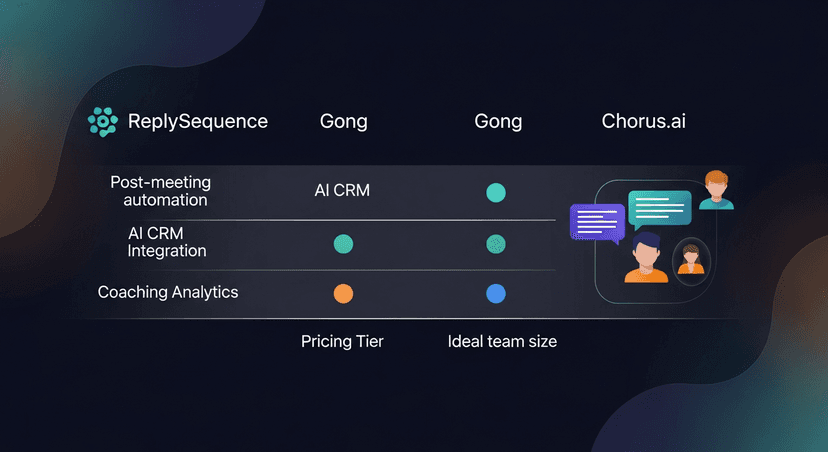
Avoma: Meeting Assistant for Revenue Teams
Best for: Mid-market teams wanting balanced features across meeting lifecycle
Avoma positions itself as an end-to-end meeting lifecycle platform, covering scheduling, note-taking, and follow-up.
Key features:
- Agenda collaboration that helps teams prepare for meetings systematically
- Live transcription and bookmarking during calls
- AI-generated summaries with key topics and moments
- Revenue intelligence tracking across customer conversations
- Meeting templates customized by meeting type
Pricing: $29/month (basic), $29/month (Pro) / $59/month (Pro+) (business), $79/user/month (enterprise)
Strengths: Affordable pricing tiers; covers full meeting lifecycle; user-friendly interface
Limitations: Less sophisticated follow-up automation than specialist tools; AI accuracy varies
Ideal customer: Growing sales teams (10-50 reps) who want comprehensive meeting support without enterprise complexity
Fireflies.ai: Scalable Note-Taking and Transcription
Best for: Budget-conscious teams prioritizing accurate transcription
Fireflies built its reputation on excellent transcription accuracy at aggressive price points, then added meeting intelligence features.
Key features:
- High-accuracy transcription across major video platforms
- Searchable conversation library with keyword and topic filters
- Soundbites and snippets for sharing key moments
- Basic CRM integration for logging call summaries
- Collaboration comments on transcript sections
Pricing: Free tier available, $10/user/month (pro), $29/month (business)
Strengths: Exceptional value; reliable transcription; easy to deploy
Limitations: Limited automation capabilities; basic follow-up features; less sales-specific intelligence
Ideal customer: Small sales teams or solo founders who need reliable meeting documentation without significant investment
Otter.ai: Cross-Functional Meeting Platform
Best for: Organizations wanting one meeting tool across all departments
Otter serves broader use cases than sales-specific platforms, making it popular for companies wanting standardized meeting tools.
Key features:
- Real-time collaboration with shared live transcripts
- Automated slide capture from screen shares
- Vocabulary customization for industry terms
- Integration with Zoom, Teams, Google Meet
- Mobile apps for on-the-go access
Pricing: Free tier, $16.99/user/month (pro), $30/user/month (business)
Strengths: Excellent for cross-functional teams; intuitive interface; strong mobile experience
Limitations: Generic rather than sales-optimized; minimal automation; basic CRM connections
Ideal customer: Companies wanting one meeting solution for sales, marketing, product, and operations
AI CRM Integration for Sales Teams: What Actually Matters
The promise of AI CRM integration sounds compelling: meetings automatically update your CRM, eliminating double data entry. The reality varies dramatically by platform.
Shallow vs. Deep Integration
Shallow integration means:
- Meeting transcripts attach to opportunity records
- Basic activity logging shows a meeting occurred
- Manual copying required to populate specific fields
Deep integration delivers:
- Automatic field updates based on conversation content (budget discussed, timeline mentioned, decision criteria identified)
- Opportunity stage advancement when buying signals indicate deal progression
- Task creation for action items assigned during calls
- Contact role identification that maps decision-makers mentioned in conversations
- Custom object updates for complex sales processes with multiple sub-processes
The difference impacts actual time savings. Shallow integrations reduce admin time by 20-30%. Deep integrations eliminate 70-80% of post-meeting CRM work.
Platform-Specific Integration Strength
Salesforce receives the most development attention, typically getting features first and integration depth. HubSpot follows closely, especially for mid-market focused tools. Pipedrive, Microsoft Dynamics, and Zoho see more variable support.
Before committing to a platform, verify:
- Which CRM fields automatically populate from meeting data
- Whether custom fields specific to your process receive updates
- How the platform handles your particular sales stage definitions
- Whether integration requires middleware like Zapier or works natively
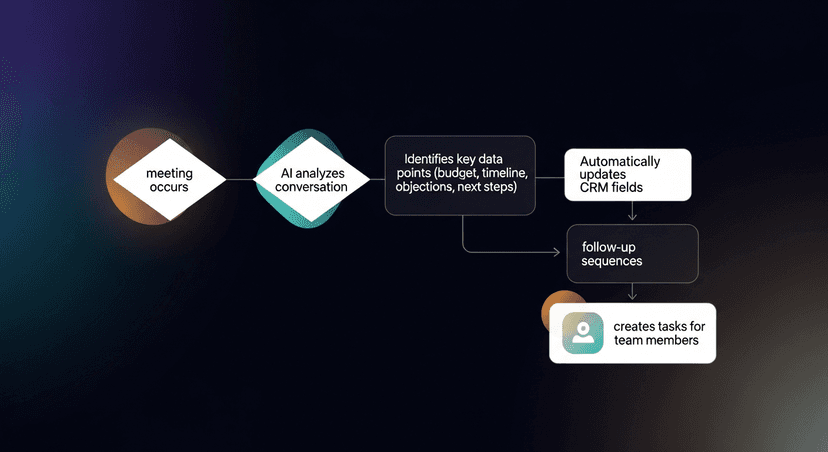
ReplySequence specializes in deep CRM integration, particularly for Salesforce and HubSpot users. The platform automatically updates deal stages, creates follow-up tasks, and triggers appropriate sequences based on conversation outcomes, handling the complete post-meeting workflow without manual CRM work.
Building Your AI Meeting Management Tech Stack
The most effective sales organizations don't rely on a single tool, they build integrated stacks where AI meeting management connects with:
Sales Engagement Platforms
Tools like Outreach, Salesloft, and Apollo work alongside meeting management systems:
- Post-meeting sequences triggered based on call outcomes
- Automatic pause/resume of cadences when meetings get scheduled
- Follow-up personalization using insights from previous conversations
- Multi-channel coordination that aligns email, calls, and LinkedIn outreach
The integration prevents prospects from receiving automated outreach when personalized follow-up is already underway.
Revenue Intelligence Platforms
When meeting data flows into revenue intelligence systems, sales leaders gain:
- Pipeline health indicators based on conversation quality and commitment language
- Deal risk scoring that identifies at-risk opportunities before they slip
- Win/loss analysis that correlates conversation patterns with outcomes
- Forecasting accuracy improved by conversation-based predictive signals
This combination turns every meeting into strategic intelligence, not just tactical follow-up.
Sales Coaching and Enablement
Meeting recordings become coaching assets when properly organized:
- Objection handling libraries compiled from successful conversations
- New hire onboarding accelerated through example calls
- Product launch training using early customer conversations
- Competitive positioning refined based on actual comparison discussions
Platforms with strong collaboration features multiply the value of each recorded conversation.
Implementation Best Practices for Sales Teams
Choosing the right AI meeting management for sales is only half the equation. Successful deployment requires:
Clear Usage Policies
Establish guidelines covering:
- Which meetings get recorded (all external calls, internal calls only when beneficial, etc.)
- Consent protocols that comply with two-party consent states and international regulations
- Internal sharing rules defining who accesses which conversation recordings
- Data retention policies balancing insight value against storage costs and compliance
- Bot naming conventions so prospects understand what's joining calls
Ambiguous policies lead to inconsistent adoption and potential compliance issues.
Adoption and Change Management
Sales reps resist tools that create extra work. Successful rollouts:
- Lead with time savings, not monitoring or oversight
- Showcase specific examples of automated follow-ups saving 20+ minutes per call
- Celebrate early adopters who demonstrate measurable improvement
- Integrate into existing workflows rather than requiring new habits
- Provide quick wins within the first week of usage
Framing the technology as "personal assistant" rather than "call recording software" improves reception significantly.
Continuous Optimization
The best sales teams treat AI meeting management as evolving systems:
- Review automation quality monthly, adjusting templates and triggers
- Analyze follow-up engagement rates, optimizing message timing and content
- Compare conversion metrics between AI-managed and manual follow-ups
- Gather rep feedback on which automations save time versus create confusion
- Update custom vocabulary as product naming and positioning evolve
Static implementations deliver declining value as sales processes and market dynamics change.
Pricing Models and Total Cost of Ownership
AI meeting management platforms use varying pricing structures that affect actual costs:
Per-User vs. Per-Meeting Pricing
Most platforms charge per user monthly, typically ranging from $10-100+ depending on feature tier. This works well for consistent meeting volume.
Some newer entrants offer per-meeting pricing, beneficial for organizations with sporadic external calls but many internal meetings.
Feature Tier Differences
Common tier structures:
- Basic: Transcription and recording storage with limited integrations
- Professional: CRM integration, basic automation, extended storage
- Business: Advanced AI features, custom integrations, dedicated support
- Enterprise: Unlimited usage, custom AI training, white-glove service
The jump from Professional to Business tiers often unlocks the features that drive actual ROI, particularly deep CRM integration and sophisticated automation.
Hidden Costs to Consider
- Implementation and training (especially for enterprise platforms requiring custom configuration)
- Integration middleware if native connections don't exist for your tech stack
- Additional storage for organizations with large meeting volumes
- Premium support often required for timely issue resolution
- User seat management as teams grow and contract
Calculate total cost of ownership across 12-24 months, not just monthly per-seat pricing.
Future Trends in Sales Meeting Automation
The AI meeting management category continues rapid evolution. Expect these developments through 2026-2027:
Proactive Deal Guidance
Moving beyond summaries to real-time recommendations:
- Next-best-action suggestions based on similar won/lost deals
- Objection handling prompts that appear during relevant conversation moments
- Resource recommendations suggesting case studies or documentation to share
- Competitive battlecard triggers when competitors get mentioned
AI will shift from documenting conversations to actively improving them in real-time.
Cross-Meeting Intelligence
Connecting insights across entire buying committees:
- Stakeholder mapping that builds org charts from conversation references
- Message consistency tracking ensuring alignment across multiple touchpoints
- Sentiment trending that identifies relationship deterioration before deals stall
- Champion identification based on advocacy language patterns
Deals involve multiple meetings with various stakeholders, AI will connect these conversations into unified intelligence.
Behavioral Prediction
Advanced AI models will forecast:
- Likelihood to close based on conversation quality versus stage
- Churn risk signals detected in customer conversations
- Expansion opportunities identified from usage discussions
- Renewal readiness predicted from health check calls
Meeting data will become primary input for revenue predictive models.
Making Your Selection: Decision Framework
Use this framework to evaluate which AI meeting management platform fits your needs:
If your primary pain point is inconsistent follow-up and deal velocity:
Choose: ReplySequence or similar post-meeting automation specialists
Why: These platforms excel at the critical post-meeting window, ensuring immediate, personalized follow-up that keeps deals moving. The deep CRM integration means insights automatically flow into your sales process without manual work.
If you need comprehensive coaching and revenue intelligence:
Choose: Gong or Chorus.ai
Why: Enterprise-grade conversation intelligence provides coaching insights, competitive intelligence, and forecasting capabilities that justify premium pricing for larger teams.
If you want balanced features at mid-market pricing:
Choose: Avoma or similar full-lifecycle platforms
Why: These tools cover scheduling, note-taking, and basic follow-up at accessible price points, ideal for growing teams not ready for enterprise complexity.
If transcription accuracy is your primary need:
Choose: Fireflies.ai or Otter.ai
Why: Excellent transcription at low price points serves teams who need reliable documentation but can handle follow-up manually.
Key Questions to Answer Before Deciding:
- What percentage of post-meeting admin time could we reclaim? (This determines ROI justification)
- Which CRM fields must update automatically? (This defines required integration depth)
- Who needs access to meeting recordings? (This impacts security and sharing requirements)
- How many meetings per rep per week? (This affects per-user versus per-meeting pricing preference)
- What's our timeline for seeing ROI? (This influences implementation complexity tolerance)
Conclusion: Choosing AI Meeting Management That Drives Revenue
The best AI meeting management for sales doesn't just document conversations, it accelerates deal velocity through intelligent automation. In 2026, the technology has matured beyond transcription to deliver genuine competitive advantage through faster, more consistent follow-up and deeper CRM integration.
The right platform choice depends on your specific workflow challenges. Teams struggling with follow-up consistency and deal velocity benefit most from automation specialists like ReplySequence. Organizations prioritizing coaching and analytics succeed with conversation intelligence platforms like Gong. Growing teams often find the best value in balanced mid-market solutions.
What remains consistent across successful implementations: AI meeting management delivers measurable ROI through reclaimed time and improved conversion rates. Sales reps spend less time on administrative work and more time actually selling. Prospects receive faster, more personalized follow-up. Deals progress systematically rather than stalling in post-meeting limbo.
The question isn't whether to adopt AI meeting management, it's which platform aligns with your sales motion and delivers the specific automation your team needs.
Ready to see how automated post-meeting follow-up improves your deal velocity? Visit replysequence.com to learn how intelligent follow-up sequences keep prospects engaged and deals moving forward without manual admin work.
How ReplySequence handles this
ReplySequence takes any meeting transcript, paste it in from Zoom, Teams, Meet, WebEx, Fireflies, Granola, or wherever, and drafts a context-rich follow-up email in about 8 seconds. You review it, make any edits, and approve. Deal intelligence builds automatically.