Automating MEDDIC Scoring From Call Data
The call ends and everyone agrees it went well. Two days later you're staring at a MEDDIC field in Salesforce trying to remember if the prospect actually named a champion or if you just assumed it because they seemed enthusiastic on the call.
This is the actual failure mode of MEDDIC. Not the framework: the framework is fine. The failure is that reps fill in Metric, Economic Buyer, Decision Criteria, Decision Process, Identify Pain, and Champion from memory, an hour or a day after the call, when the specific words are already gone and all that's left is a vibe. "Seemed like a champion" becomes a Champion score of 8. "They mentioned budget stuff" becomes an Economic Buyer field with a name in it that nobody actually confirmed.
The fix is mechanical, not conceptual: pull all six MEDDIC fields directly out of the transcript, tied to a specific quote, before memory has time to fill in the gaps with hope.
Why MEDDIC scores are usually a guess, not a record
MEDDIC was built to force discipline into qualification. In practice, the CRM field becomes a post-call recap written from a rep's general impression of how the call went. That's a subjective summary wearing a structured framework's clothes.
This matters more than it looks like on the surface. Research into deal-intelligence pain points on Reddit and Hacker News found that critical deal signals routinely exist in call transcripts and conversations but never get converted into structured data attached to the CRM record, leaving scoring, prediction, and coaching all running on incomplete inputs. A MEDDIC field filled from memory isn't a data point. It's a guess with a form field around it, and every downstream process (forecast rollups, deal review, coaching) inherits that guess as if it were fact.
The same research flagged champion and stakeholder change as the highest-leverage undetected signal in the entire deal-intelligence stack, showing up in ghosting after a champion departs, in scoring that never models multi-stakeholder risk, and in forecasts that collapse when an acquisition wipes out committed pipeline. If your Champion field was a guess to begin with, you have no baseline to notice when it changes.
What you need before you can automate this
Three things, none of them exotic:
- A transcript. From whatever you already use, Fireflies, Otter, Fathom, Granola, or the native transcript export from Zoom, Teams, or Meet. No new bot, no new tool.
- A MEDDIC field template. Six labeled slots: Metric, Economic Buyer, Decision Criteria, Decision Process, Identify Pain, Champion.
- A place to log it. Your CRM, a shared doc, whatever your team already checks before a deal review.
That's it. No calendar integration, no meeting bot required to join the call. If you have a transcript sitting in a folder from last week's call, you already have everything you need to start.
Step 1: Pull the transcript, not the recap
Don't open the CRM and start typing from what you remember. Open the transcript export (the .txt or .vtt file, or the raw text view inside Fireflies/Otter/Fathom) and work from that.
The recap your recorder auto-generates is already one layer removed from the source. AI-generated call summaries are useful for a quick skim, but they compress and interpret, exactly the kind of lossy step that turns "we're losing about 40 hours a month on this" into a generic bullet like "discussed efficiency concerns." You want the sentence, not the summary of the sentence.
Step 2: Tag each MEDDIC letter to a direct quote
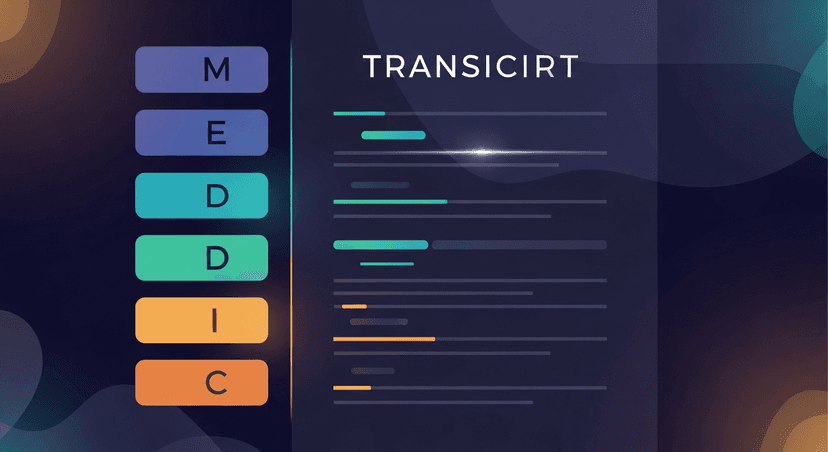
Go through the transcript and find the line that supports each MEDDIC category. Not a paraphrase of the line: the line itself, in quotes, next to the field.
Metric: "We're losing about 40 hours a month on this across the team."
Economic Buyer: "I'd need to loop in [Name], she owns the budget for this."
Decision Criteria: "The main thing is whether it integrates with what we already have in [Tool]."
Decision Process: "We usually run a 30-day pilot before anything goes to procurement."
Identify Pain: "Right now it's all manual and someone has to babysit it every week."
Champion: "I've been pushing for something like this for months."
If you can't find a line that maps to a field, leave it blank. That's the whole method in one sentence: the field is only as strong as the quote behind it.
Step 3: Flag the fields with no supporting quote as gaps, not guesses
This is the step most reps skip, and it's the one doing the actual work. If nobody on the call named an Economic Buyer, the field stays blank or gets flagged "unconfirmed": it does not get filled in with your best guess at who probably signs off.
A blank field is honest information: it tells the next person reading the deal that this hasn't been verified yet, and that the next call needs to ask directly. A guessed field is worse than blank, because it looks confirmed. That's exactly the mechanism behind the champion-departure problem in the research above, when a deal goes quiet, reps can't tell organic ghosting from genuine deal death because the CRM data they're working from was never solid to begin with. A field that says "Champion: unconfirmed" is a flag that tells you to go find out. A field that says "Champion: Sarah" because she seemed into it gives you false confidence right up until she stops answering emails.
Step 4: Score Champion strength from language, not title
Title tells you almost nothing. "VP of Operations" can be a champion or can be someone who never mentions your deal again after the call ends. What actually predicts champion strength is the pronoun.
High-strength champion language uses first-person plural: they've mentally merged with the deal:
"We need this by Q3, no question."
"I'll get this in front of my boss this week."
"This is exactly the gap we've been trying to close."
Low-strength, distancing language uses third person or hedged phrasing: they're describing someone else's decision, not their own:
"They'd probably need to sign off on something like this."
"I think leadership would be open to it."
"Someone would have to run the numbers."
Score the Champion field on that distinction, not on job title. And re-check it every call: a champion who used "we" language in call one but shifts to "they" language in call three is giving you an early signal that something changed internally, well before the silence starts. That's the exact blind spot the research flagged: no current tool systematically tracks contact-level language shift as a deal-risk variable, so it falls on the rep to notice it manually, call over call.
Step 5: Turn the scored MEDDIC record into the actual follow-up email
Once Metric and Decision Criteria are pulled and quoted, the best use of them isn't just sitting in a CRM field: it's going back to the prospect in the follow-up email, in their own words, as a confirmation move:
Subject: Following up: the 40 hours/month and the integration question

Hi [First Name],

Good catch-up today. Wanted to confirm what I heard:

- You're losing around 40 hours a month on the manual process right now
- Integration with [Tool] is the deciding factor for your team
- You'll be looping in [Name] once we've nailed down the integration piece

Let me know if I've got any of that wrong, otherwise I'll get you the integration details by Friday.

[Your name]
That email isn't generic, every line traces back to a quote you already pulled in Step 2. This is where doing the manual work pays off twice: once for the CRM record, once for a follow-up that makes the prospect feel heard instead of processed.
This is also the step I built ReplySequence around. It doesn't score MEDDIC: that judgment call is still yours. But once you've got the transcript, ReplySequence reads it and drafts a follow-up like the one above in about 60 seconds, pulling the same Metric and Decision Criteria language straight from what the prospect said. No bot has to sit in the meeting, paste the transcript from Fireflies, Otter, Fathom, Granola, or a Zoom/Teams/Meet export, and the draft comes back ready to review and send from your own inbox. BYOT: bring your own transcript, RS handles the last mile.
Common ways this breaks down
- Filling gaps with hope instead of leaving them blank. The whole point of Step 3 is resisting this. A guessed Economic Buyer field is more dangerous than an empty one.
- Not tracking contact-level changes. A champion who goes quiet, changes job title, or shifts from "we" to "they" language is giving you a signal most CRMs have no field for. Log it somewhere, even a plain note, because the standard MEDDIC template won't catch it for you.
- Treating one call's score as permanent. MEDDIC isn't a form you fill out once. Re-score Champion and Decision Criteria after every call: a deal that scored well in week one and hasn't been rescored since is running on stale data, not current reality.
- Trusting the auto-recap over the raw transcript. Summaries are useful for a fast skim, but they smooth out the exact phrasing that separates "we need this" from "they'd probably sign off." Go back to the source when the field actually matters.
MEDDIC was never broken. It just needed a source document instead of a memory.
How ReplySequence handles this
ReplySequence takes any meeting transcript, paste it in from Zoom, Teams, Meet, WebEx, Fireflies, Granola, or wherever, and drafts a context-rich follow-up email in about 8 seconds. You review it, make any edits, and approve. Deal intelligence builds automatically.