Detect Deal Risk From Sales Call Transcripts
By the end of this guide you'll have a repeatable process for reading a sales call transcript and flagging the signals that predict a stalled or lost deal, before the silence starts. The approach is straightforward: a call transcript already contains the deal risk signals that CRMs miss. You just need to know exactly what patterns to scan for, and what to do when you find them.
What you need before you start
You need three things:
- A transcript from any source. Fireflies, Otter, Fathom, Granola, Zoom, Teams, Google Meet, or a pasted doc. The source doesn't matter: the text does.
- The deal's current stage in your CRM. You're cross-referencing what the transcript says against what Salesforce (or HubSpot, or whatever you use) thinks is true.
- A clear sense of who your champion is. Name, title, and when you last confirmed they're still in that role.
No special tooling required for this pass. A transcript and a notepad work fine.
—-
Step 1: Scan for champion and stakeholder language
Champion departure is the highest-leverage undetected deal signal in most pipelines. Research consistently surfaces this: an AE won't find out their champion left until weeks of silence have passed and the deal is effectively dead. CRMs don't track contact-level role changes, and no alert fires when the person who sponsored the deal goes quiet.
Scan the transcript for these phrases and flag every one:
- "I'll need to loop in the new CFO on this."
- "Sarah's actually moved to a different team: you'd probably want to talk to Marcus now."
- "We've had some leadership changes recently."
- "I'm not sure I'm the right person to sign off on this anymore."
- "Things have shifted a bit on our end organizationally."
Any reference to a new stakeholder, a role change, or someone being reassigned is a yellow flag. If your named champion mentions they no longer own the budget or the decision, that's a red flag, even if they say it casually.
—-
Step 2: Flag silence patterns embedded in the conversation
Ghosting rarely comes from nowhere. The transcript from the last call usually contains the warning signs: you just have to look for them.
The core problem: CRM activity logs show that follow-up emails were sent, not whether the underlying deal is alive. A rep can send six "bumping this to top of your inbox" emails into a void and the CRM still shows "Active."
Phrases that predict upcoming silence:
- "Probably Q3, once things settle down."
- "Let me check internally and get back to you." (with no specific date attached)
- "We're still early in our evaluation process." (on call 4 of a 90-day cycle)
- "I'll have to run this by a few more people."
- "It's on our radar, just not a priority right now."
Vague next-step commitments and hedged timelines are the transcript equivalent of a yellow light. Flag any "next step" that has no date, no owner, and no specific action.
—-
Step 3: Listen for external-disruption signals
Macro disruptions (budget freezes, tariffs, org restructures, political uncertainty) cause buyers to pause deals without formally saying so. The pipeline looks healthy in Salesforce. The conversations have effectively stopped.
Prospects rarely announce a pause. They embed it in the transcript language:
- "We're in a bit of a hold right now."
- "Things are up in the air internally: I wouldn't want to make any commitments until the dust settles."
- "We're re-evaluating a few vendors at the moment."
- "Budget's frozen through the end of the quarter."
- "There's been a lot going on at the company level: I'll be honest with you."
"Re-evaluating vendors" after a champion change is the specific combination that kills committed pipeline. If you see both in the same transcript, that deal needs immediate attention: not a nurture sequence.
—-
Step 4: Check for MEDDIC gaps in the transcript
A missing MEDDIC element after a certain call depth is a risk signal on its own. Map what the transcript confirms and what it doesn't.
Economic Buyer
Gap-negative (risk): "I'll bring it to leadership.": no name, no title, no meeting scheduled.
Gap-positive (safe): "The final sign-off is David Park, our VP Finance: I can get him on the next call."
Decision Criteria
Gap-negative: "We're looking at a few options.": no criteria stated.
Gap-positive: "We need SOC 2 compliance, Salesforce native integration, and under $500/seat."
Timeline
Gap-negative: "Probably sometime this year."
Gap-positive: "We need to be live before the July 1 contract renewal with our current vendor."
Identified Pain
Gap-negative: "It would be nice to improve our follow-up process." (aspiration, not pain)
Gap-positive: "We lost two deals last quarter because reps didn't follow up within 48 hours."
If you're on call 3+ and the Economic Buyer hasn't been named, flag it. That's not a relationship issue: it's a qualification gap.
—-
Step 5: Score the call and tag the CRM
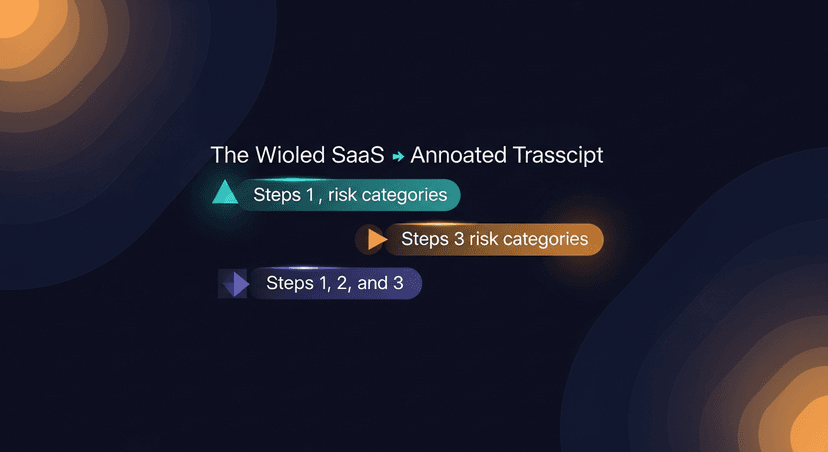
Count the red flags from Steps 1–4 and assign a risk tier:
- Green: 0–1 flags. Deal progressing. Standard follow-up.
- Yellow: 2–3 flags. One or more risk signals present. Follow-up needs to address them directly.
- Red: 4+ flags, OR any combination of champion change + "re-evaluating" language. Escalate or multi-thread immediately.
Then write a one-line CRM note with the specific evidence from the transcript: not a gut feeling.
What a useful CRM note looks like:
> "Yellow. Champion mentioned 'new CFO re-evaluating vendors' (call 4, ~14:30). No Economic Buyer named. Timeline: 'probably Q3.' Next step: confirm Marcus is still champion; request CFO intro before next demo."
What a useless CRM note looks like:
> "Good call. Following up next week."
The evidence is what makes the next deal review actionable. Without it, the note is noise.
—-
Step 6: Write the follow-up email that addresses the risk directly
This is where most reps lose the signal they just found. They do the transcript scan, see the yellow flags, then send a generic recap email that ignores all of them.
Yellow-flag follow-up (vague next steps, hedged timeline):
Subject: Next step for [Company], confirming [Date]

Hi [First Name],

Wanted to confirm what we landed on: [specific next step] on [specific date].

You mentioned timing was tied to things settling down internally, does [date] still work, or should we find a better window?

[Your Name]
Red-flag follow-up (champion change + re-evaluating language):
Subject: [Company] evaluation, right people on next call?

Hi [First Name],

Given the leadership changes you mentioned, I want to make sure we're not wasting your time.
Would it make sense to include [New Stakeholder / CFO] on the next conversation so we can address their criteria directly?

Happy to prep a one-pager specific to their priorities beforehand.

[Your Name]
If you don't want to write this manually after every call, ReplySequence takes the transcript and returns a drafted follow-up in 60 seconds, and the draft reflects the tone and context of what was actually said in the meeting, not a generic template. 14-day Pro trial, no credit card.
—-
Three mistakes that kill your risk detection process
1. Only scanning for risk after the deal goes quiet.
By then, the champion has already left, the budget is already frozen, and the prospect has already short-listed a competitor. The transcript from the last active call had the signals. You needed to read it then.
2. Trusting CRM activity logs over transcript language.
A log that shows "6 follow-up emails sent" tells you a rep was persistent. It tells you nothing about whether the deal is alive. The transcript tells you what the prospect actually said. Those are different data sets.
3. Flagging risk without writing specific evidence into the CRM note.
If the note says "feels risky" with no quote, no timestamp, no MEDDIC gap called out: the next deal review has nothing to work with. The whole point of the process is to turn transcript language into structured CRM data. If you skip the note, you've done half the job.
—-
Run this scan on your next three calls and you'll see the pattern fast. Most at-risk deals show two or three of these signals in the same transcript: they just never get flagged because nobody's reading for them. The transcript is already there. The signals are already in it. You just have to look.
How ReplySequence handles this
ReplySequence takes any meeting transcript, paste it in from Zoom, Teams, Meet, WebEx, Fireflies, Granola, or wherever, and drafts a context-rich follow-up email in about 8 seconds. You review it, make any edits, and approve. Deal intelligence builds automatically.