5 Sales Productivity Habits That Move the Needle
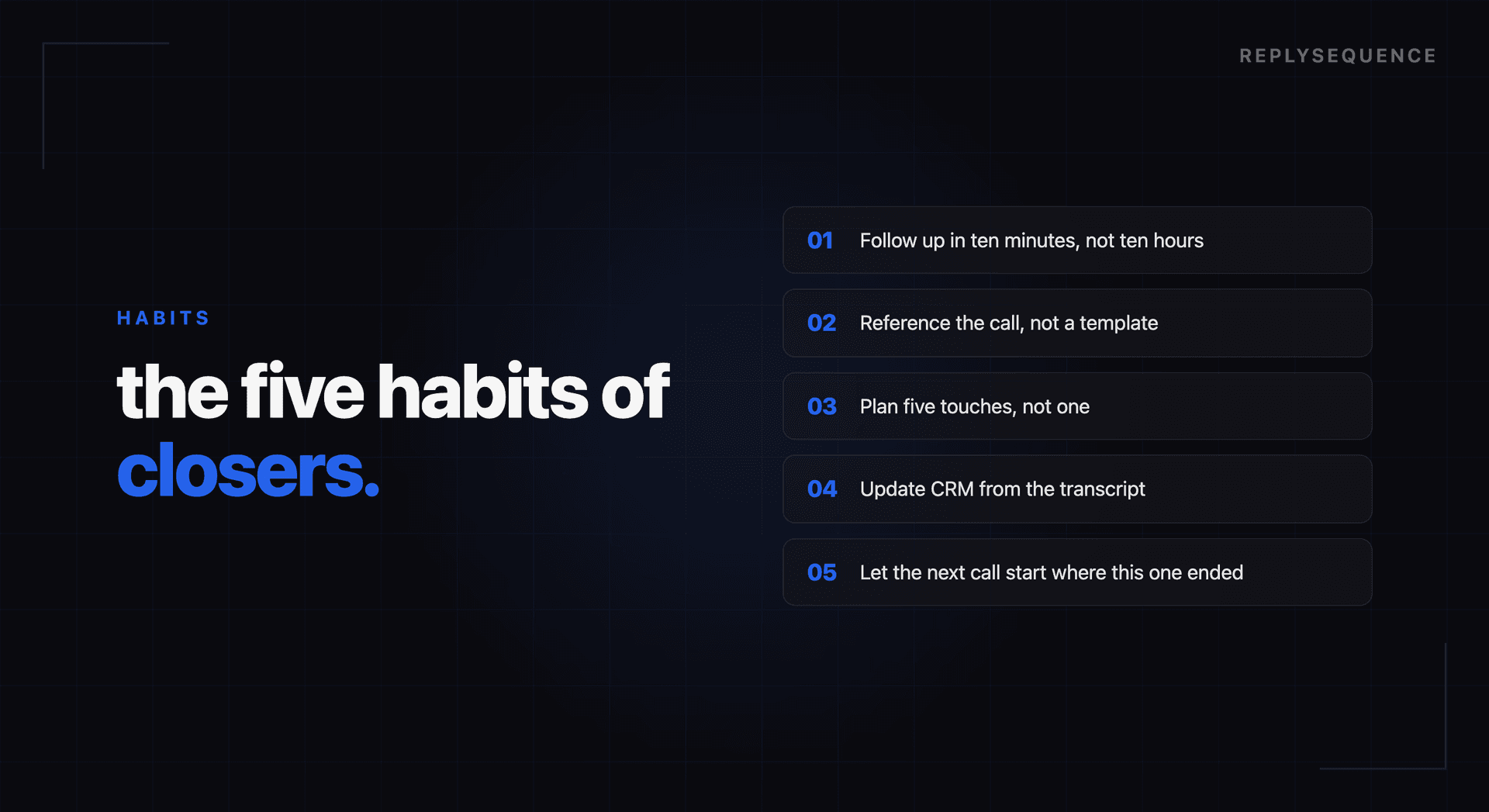
Sales productivity advice tends to fall into two camps: vague motivational tips ("be more disciplined with your time") or overly tactical CRM tutorials that miss the bigger picture. Neither helps you close more deals.
After studying the workflows of top-performing reps across SaaS, consulting, and professional services, five habits consistently separate the closers from the rest. None of them involve waking up at 5 AM.
1. Treat Every Meeting as a Pipeline Event
Average reps attend meetings. Great reps treat every meeting as a trigger for at least one downstream action: a follow-up email, a CRM update, a next meeting booked, or a proposal sent.
The habit is simple: never end a meeting without knowing exactly what happens next and who owns it. Then execute that action within 60 minutes. The fastest way to do this is to automate the follow-up entirely using meeting transcript analysis, so the draft is waiting for you before your next call starts.
2. Batch Your Prospecting and Protect Your Closing Time
Context switching is the silent killer of sales productivity. Research from the University of California Irvine shows it takes an average of 23 minutes to fully re-engage after switching tasks.
Top reps do not prospect and close in the same time blocks. They batch their outbound work into 90-minute focused sessions (usually morning) and protect afternoon blocks for discovery calls, demos, and deal progression. If you are toggling between cold emails and active deal follow-ups in the same hour, you are doing both badly.
3. Automate Everything That Is Not Relationship-Building
Here is a useful filter: if a task does not require your unique knowledge of the prospect or your ability to build rapport, it should be automated or eliminated.
That includes:
- Meeting notes and summaries: let AI handle the transcript
- CRM data entry: use integrations that log activities automatically
- Follow-up email first drafts, AI can generate these from transcripts in seconds
- Calendar scheduling: use scheduling tools, stop the back-and-forth
- Pipeline reporting: automate weekly rollups
The goal is not to automate the sale. It is to automate everything around the sale so you can spend more time on the parts that actually require a human: understanding needs, building trust, and solving problems.
4. Review Your Pipeline Weekly, Not Just When Your Manager Asks
Most reps only audit their pipeline during forecast calls. By then, stale deals have been sitting for weeks, inflating your numbers and hiding the real state of your quarter.
Set a 30-minute weekly block (Friday afternoon works well) to review every open opportunity. For each deal, answer three questions: What was the last meaningful interaction? What is the specific next step? Is the timeline still realistic? If you cannot answer all three, the deal needs immediate attention or needs to be moved out of your active pipeline.
5. Invest 15 Minutes Per Day in Account Research
The reps who consistently over-perform are not just better at talking. They are better prepared. Before every call, they spend 10-15 minutes reviewing the prospect's recent news, LinkedIn activity, company announcements, and industry trends.
This is not about finding clever icebreakers. It is about walking into every conversation with enough context to ask better questions. Better questions lead to deeper discovery. Deeper discovery leads to stronger proposals. Stronger proposals close.
The Common Thread
Notice what connects all five habits: they are about reducing friction and increasing the quality of every interaction. The reps who win consistently are not working more hours. They are spending more of their hours on activities that directly advance deals, and they are ruthless about automating or eliminating everything else.
Start with one habit this week. The follow-up automation is often the highest-leverage starting point because it compounds across every meeting you take.
How ReplySequence handles this
ReplySequence takes any meeting transcript, paste it in from Zoom, Teams, Meet, WebEx, Fireflies, Granola, or wherever, and drafts a context-rich follow-up email in about 8 seconds. You review it, make any edits, and approve. Deal intelligence builds automatically.