 ReplySequence
What Should a Sales Meeting Recap Include? (And What to Leave Out)
```json
{
"title": "What Should a Sales Meeting Recap Include? (And What to Leave Out)",
"slug": "what-should-a-sales-meeting-recap-include-and-what-to-leave-out",
"excerpt": "Learn exactly what to include in a sales meeting recap, what to cut, and how the right format keeps deals moving forward faster.",
"content": "A great sales meeting recap should include four core elements: a brief context summary, agreed-upon next steps with owners and deadlines, key decisions made, and any open questions that need resolution. Everything else — filler summaries of small talk, redundant background, and vague commentary — should be cut. Getting this right is one of the most underrated skills in sales, and it directly affects whether deals progress or stall.\n\nMost reps treat the post-meeting email as a formality. The best reps treat it as a sales tool. Here's exactly how to build a recap that works.\n\n## Why What You Include in a Sales Meeting Recap Actually Matters\n\nBefore diving into the format, it's worth understanding what's at stake. Research from HubSpot shows that 80% of sales require at least five follow-ups after the initial meeting, yet the quality of those follow-ups varies wildly. A poorly structured recap creates ambiguity — the prospect isn't sure what they agreed to, the rep isn't sure what they promised, and momentum dies.\n\nA strong recap does three things simultaneously:\n- It confirms mutual understanding of what was discussed\n- It creates a written record that keeps both sides accountable\n- It advances the deal by making next steps crystal clear\n\nEvery word in your recap should serve at least one of those purposes. If it doesn't, cut it.\n\n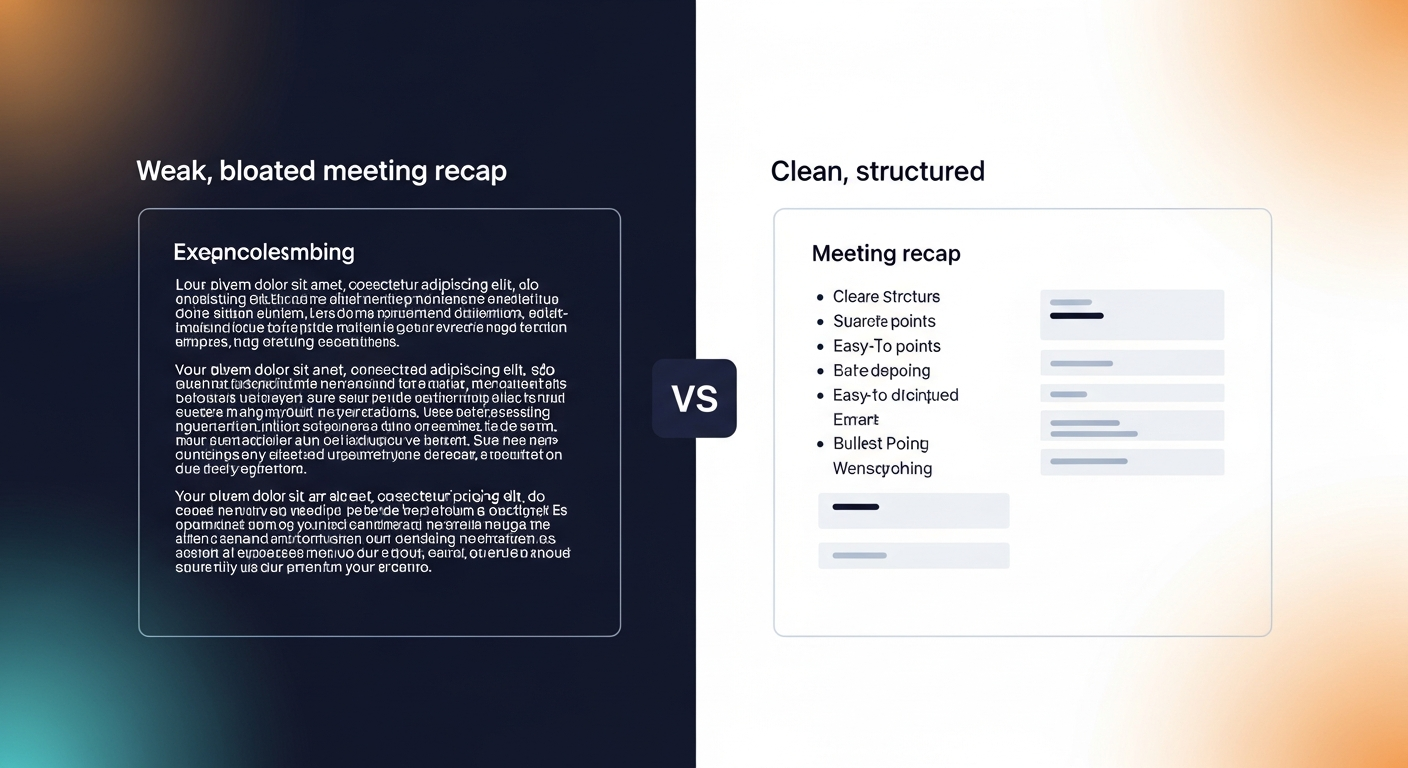 \n\n## The Essential Elements: What to Include in a Sales Meeting Recap\n\nHere's the structure that works consistently across deal sizes, industries, and sales cycles.\n\n### 1. A One-Sentence Context Line\n\nOpen with a single sentence that anchors the recap. It should name who met, when, and the core topic. That's it.\n\nExample: "Following our 30-minute call on April 6th, here's a summary of what we covered and agreed on."\n\nThis isn't padding — it's orientation. When your champion forwards this to a stakeholder who wasn't on the call, they immediately understand the context without having to ask.\n\n### 2. Key Discussion Points (3–5 Bullets Max)\n\nThis is where most reps over-write. You do not need to document everything that was said. You need to capture the outcomes and decisions that matter.\n\nFocus on:\n- Pain points the prospect confirmed (in their own words if possible)\n- Priorities or timelines they mentioned (e.g., "needs solution live before Q3 kickoff")\n- Concerns or objections raised that haven't been fully resolved\n- Criteria they're using to evaluate options\n\nKeep this to three to five bullets. If you have more than five, you're summarizing a transcript, not writing a recap.\n\n### 3. Decisions Made\n\nIf anything was explicitly agreed upon during the call, it deserves its own section. This could be as simple as agreeing to include a new stakeholder in the next meeting, or as significant as confirming a preferred pricing tier.\n\nExample bullets:\n- Agreed to move forward with a 30-day pilot starting May 1st\n- Confirmed budget authority sits with VP of Revenue, not IT\n- Decision to present to the full leadership team before contract review\n\nDocumenting decisions serves a critical function: it prevents revisiting settled ground in future conversations, which kills momentum and signals poor process.\n\n### 4. Next Steps With Owners and Deadlines\n\nThis is the single most important section of any meeting recap. According to Salesforce research, deals with clearly defined next steps are 2.5x more likely to close. Vague next steps like "we'll reconnect soon" are deal killers in written form.\n\nFormat each next step with three components:\n- What needs to happen\n- Who is responsible\n- By when\n\nExample:\n- [Rep Name] to send ROI model by Thursday, April 10th\n- [Prospect Name] to loop in CFO before next call\n- [Prospect Name] to confirm pilot scope by April 14th\n\nThis format creates natural accountability on both sides. When the prospect sees their name next to an action item with a date, they take it seriously — far more than a verbal "I'll follow up on that."\n\n### 5. Agreed-Upon Next Meeting (If Applicable)\n\nIf you booked the next call on the spot — which you should be doing — confirm it in the recap. Include the date, time, format, and any prep the prospect should bring.\n\nExample: "Our next call is scheduled for Wednesday, April 16th at 2:00 PM EST. We'll be reviewing the pilot proposal and discussing implementation timeline."\n\nThis removes any ambiguity and gives the prospect a reason to hold the calendar invite seriously.\n\n
 \n\n## What to Leave Out of a Sales Meeting Recap\n\nKnowing what to cut is just as important as knowing what to include — and most reps are far better at adding than subtracting.\n\n### Cut: Blow-by-Blow Summaries\n\nYou don't need to recap every topic in the order it was discussed. A recap isn't a transcript or a minutes document — it's a forward-looking alignment tool. If a topic was discussed but doesn't affect next steps or decisions, leave it out.\n\n### Cut: Filler Pleasantries in the Body\n\n"It was great connecting with you today!" belongs in the subject line or the sign-off, not embedded in the recap body. Every sentence in the core content should be carrying weight.\n\n### Cut: Unverified Assumptions\n\nDon't write "As we discussed, your team is definitely moving forward with a vendor this quarter" if the prospect said "we're hoping to." Inaccurate summaries — even optimistic ones — erode trust fast. Stick to what was explicitly said or confirmed.\n\n### Cut: Product Feature Dumps\n\nThe recap is not the place to re-pitch your product. If the prospect asked about a specific feature, link to a resource or note that you'll follow up separately. Don't turn your recap into a brochure.\n\n### Cut: Anything Longer Than One Screen\n\nThis is the practical test: if your recipient has to scroll to read the whole recap on a laptop, it's too long. Aim for under 250 words in the body of the email. Brevity is a feature, not a shortcut.\n\n## Real-World Scenarios: How the Format Plays Out\n\nScenario 1: Early-Stage Discovery Call\nYou spoke with a VP of Sales at a mid-market SaaS company for 30 minutes. She confirmed her team is losing deals because follow-up timing is inconsistent. The recap should capture that pain point in her language, note that she wants to see a use case from a similar company, and list the next steps: you send the case study by Wednesday, she confirms she can bring her RevOps lead to the next call by Friday.\n\nScenario 2: Late-Stage Negotiation Call\nYou're three meetings deep with an enterprise prospect. Legal has reviewed the contract, one pricing clause is still open, and you verbally agreed on a start date. The recap should document the open clause, the agreed start date, and the deadline for legal sign-off. Nothing else needs to be in there.\n\nScenario 3: Multi-Stakeholder Demo\nYou demoed to five people. Different attendees raised different concerns. The recap should consolidate the top three themes that emerged across the group — not list every individual comment — and assign next steps to both you and the primary contact.\n\n## Tools and Automation: How to Scale This Without Losing Quality\n\nOnce you have a solid meeting recap format, the challenge becomes doing it consistently across every deal, every week, without burning time. Manual recap writing is one of the biggest hidden time sinks in sales — estimates suggest reps spend 20–30 minutes per meeting writing and sending follow-ups, which adds up fast across a full pipeline.\n\nTools like ReplySequence are built specifically for this problem. ReplySequence uses AI to generate structured, personalized post-meeting follow-ups that follow the exact framework outlined here — context, key points, decisions, next steps — in seconds rather than minutes. Reps review and send, rather than draft from scratch.\n\nThe best meeting recap format in the world only works if you actually send it consistently. Automation removes the friction that causes reps to skip or delay the follow-up, which is where deal momentum usually goes to die.\n\n
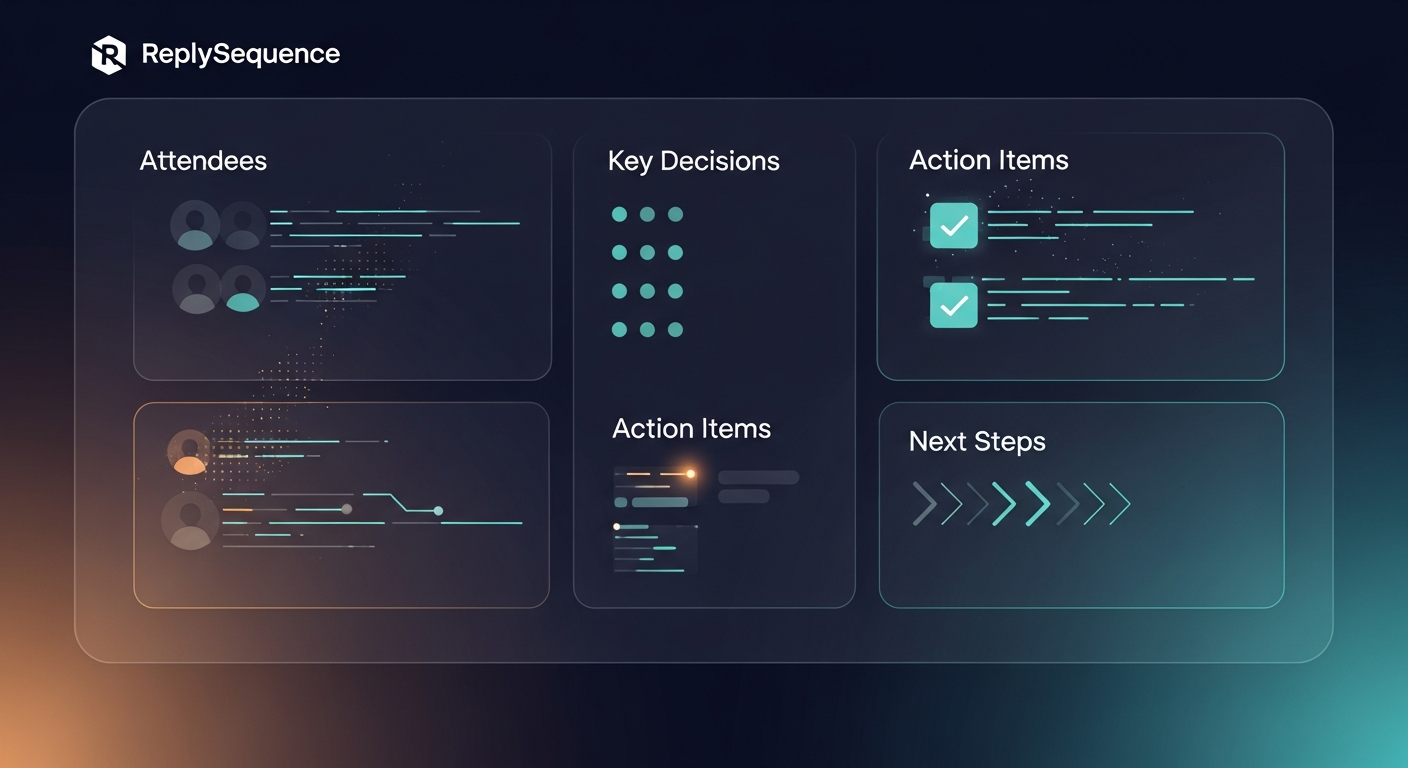 \n\n## Quick-Reference: The Winning Recap Structure\n\nHere's the format distilled into a repeatable checklist:\n\n- Opening line: Who met, when, and why (one sentence)\n- Key discussion points: 3–5 bullets — confirmed pain points, priorities, concerns, criteria\n- Decisions made: Anything explicitly agreed upon\n- Next steps: What, who, by when — for both sides\n- Next meeting: Date, time, format, and prep needed\n- Total length: Under 250 words\n\nPrint this out. Make it your template. Send it within two hours of every meeting.\n\n## The Bottom Line on What to Include in a Sales Meeting Recap\n\nKnowing what to include in a sales meeting recap — and what to ruthlessly cut — is the difference between a follow-up that advances a deal and one that just fills an inbox. Lead with next steps, keep key points tight, document decisions, and eliminate everything that doesn't serve the buyer's path forward.\n\nIf you want to send recaps like this consistently without spending 20 minutes per meeting drafting them, ReplySequence automates the entire process while preserving the quality and structure that actually moves deals. Start building better follow-up habits today at replysequence.com.",
"date": "2026-04-06",
"author": "Jimmy Hackett",
"tags": ["sales meeting recap", "meeting recap format", "follow-up emails", "sales productivity", "meeting summary template"],
"readingTime": 7,
"faqs": [
{
"question": "What should be included in a sales meeting recap?",
"answer": "A sales meeting recap should include a one-sentence context line, 3–5 key discussion points, any decisions made during the call, clearly assigned next steps with owners and deadlines, and confirmation of the next scheduled meeting. Keep the total length under 250 words."
},
{
"question": "How long should a sales meeting recap email be?",
"answer": "A sales meeting recap email should be under 250 words — short enough to read in a single screen view on a laptop. Anything longer risks being ignored or skimmed, which defeats the purpose of sending it."
},
{
"question": "What should you leave out of a meeting recap?",
"answer": "Leave out blow-by-blow conversation summaries, filler pleasantries in the body copy, unverified assumptions about the prospect's intent, product feature descriptions, and any content that doesn't directly support next steps or decision documentation."
},
{
"question": "What is the best format for a meeting recap?",
"answer": "The best meeting recap format includes five labeled sections: a context line, key discussion points as bullets, decisions made, next steps with assigned owners and due dates, and the confirmed next meeting details. This structure ensures alignment and creates accountability on both sides."
},
{
"question": "How soon should you send a sales meeting recap after a call?",
"answer": "Send a sales meeting recap within two hours of the meeting ending. The faster you send it, the more relevant the context is for both parties — and the stronger the signal that you're organized and serious about the deal."
}
]
}
```
How ReplySequence handles this
ReplySequence connects to your Zoom, Teams, or Meet calls, reads the transcript, and drafts a context-rich follow-up email in about 8 seconds. You review it, make any edits, and send from your real inbox. Deal intelligence builds automatically.