 ReplySequence
Follow-Up Email After Sending a Proposal: What to Say
```json
{
"title": "Follow-Up Email After Sending a Proposal: What to Say",
"slug": "follow-up-email-after-sending-a-proposal-what-to-say",
"excerpt": "Not sure what to say in a follow-up email after sending a proposal? Learn exactly what to write, when to send it, and how to keep deals moving forward.",
"content": "A follow-up email after sending a proposal should do three things: confirm the prospect received it, invite questions, and create a soft next step without applying pressure. Most deals stall not because the prospect said no — but because no one followed up at the right time, with the right message.\n\nResearch from the Sales Management Association consistently shows that 44% of salespeople give up after just one follow-up, even though the majority of closed deals require five or more touchpoints. If your proposal is sitting in someone's inbox with no reply, the fix is rarely the proposal itself — it's the follow-up sequence around it.\n\nHere's exactly what to say, when to say it, and how to structure each follow-up touchpoint after you've sent a quote or proposal.\n\n## Why Most Proposal Follow-Ups Fall Flat\n\nBefore getting into templates, it's worth understanding why generic follow-up emails fail. The biggest culprits:\n\n- "Just checking in" messages — These add zero value and signal that you have nothing new to offer\n- Following up too soon or too late — Emailing two hours after sending feels pushy; waiting two weeks feels forgotten\n- No clear call to action — Ending with "Let me know if you have questions" puts the burden entirely on the prospect\n- One-size-fits-all language — A proposal follow-up for a $500 project should sound different from one for a $50,000 contract\n\nThe goal of every proposal follow-up email isn't to beg for a decision. It's to remove friction, answer unspoken questions, and make it easy to say yes.\n\n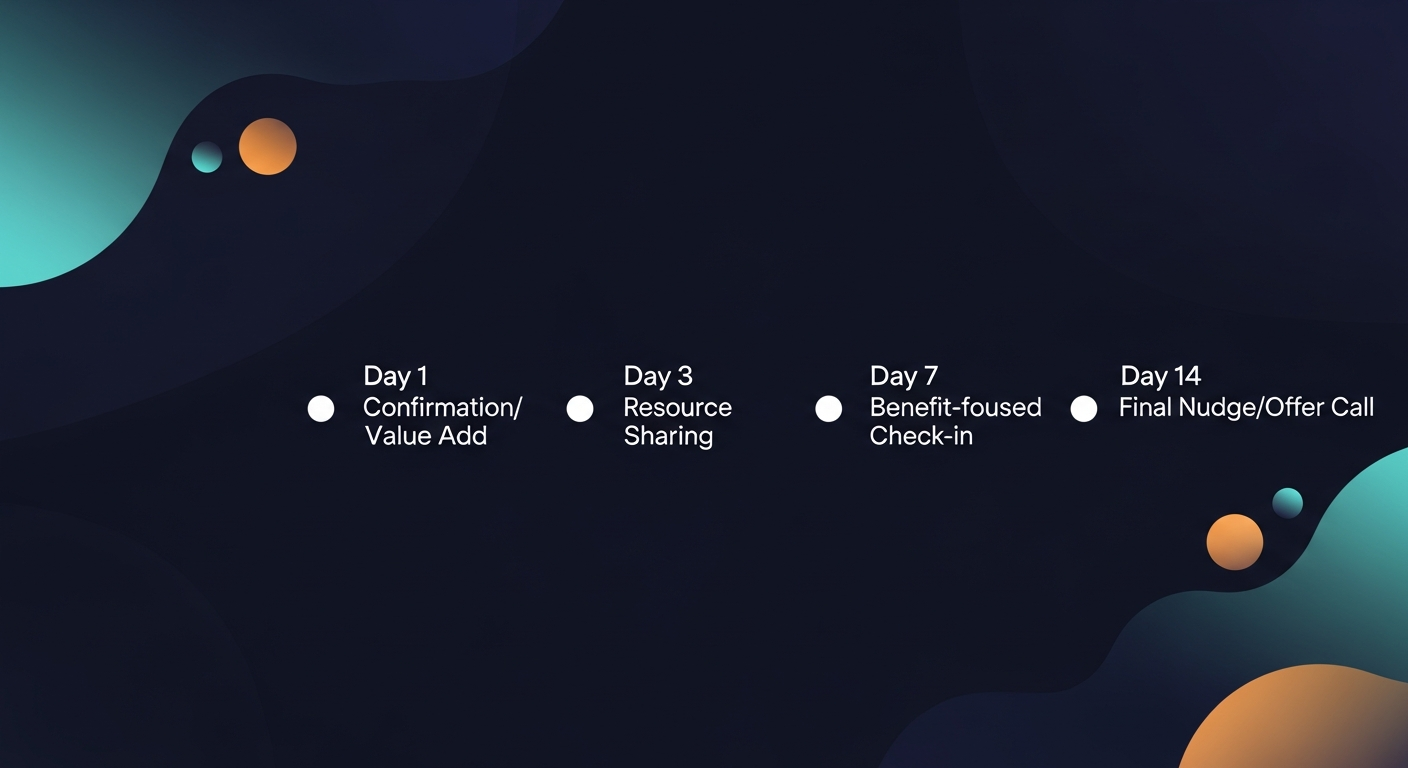 \n\n## The Ideal Follow-Up Timeline After Sending a Proposal\n\nTiming matters as much as the message itself. Here's the framework that works across most B2B sales cycles:\n\n- Same day (or within 24 hours): Confirmation email — make sure they received it and set expectations for next steps\n- Day 3: First follow-up — address common questions, highlight a key outcome from the proposal\n- Day 7: Second follow-up — share a relevant case study or social proof, re-open the conversation\n- Day 14: Breakup or bump email — low-pressure, creates urgency without ultimatums\n\nThis cadence works for most mid-cycle deals. For enterprise proposals with longer review processes, you might stretch Day 7 to Day 10 and Day 14 to Day 21.\n\n## What to Say in Each Follow-Up Email\n\n### Email 1: The Confirmation (Same Day or Next Morning)\n\nThis email serves as a bridge between sending the proposal and waiting for a response. It's short, warm, and sets the stage.\n\nSubject line: Your proposal from [Your Company] — quick note\n\n> Hi [Name],\n>\n> Just wanted to make sure the proposal landed in your inbox without any issues — sometimes these things end up in spam or get buried.\n>\n> The document covers [brief 1-sentence summary of what's inside]. If anything looks off or you'd like to talk through any section before your team reviews it, I'm happy to jump on a quick call.\n>\n> I'll plan to follow up on [specific date]. Looking forward to hearing your thoughts.\n\nWhy it works: You're not asking for a decision — you're confirming receipt, summarizing value, and setting a concrete next touchpoint. That last sentence alone significantly increases response rates because it tells the prospect when to expect to hear from you again.\n\n### Email 2: The Value Add (Day 3)\n\nBy day three, your proposal follow-up email should remind them why they asked for a proposal in the first place. Pull a specific pain point from your discovery call and connect it to the proposal.\n\nSubject line: One thing I wanted to highlight in the proposal\n\n> Hi [Name],\n>\n> I've been thinking about what you mentioned on our call — specifically [pain point or goal they shared]. Section [X] of the proposal addresses this directly, and I wanted to make sure it didn't get lost in the details.\n>\n> [One or two sentences explaining how your solution solves that specific problem.]\n>\n> Are there any questions from your side before you bring this to the team?\n\nWhy it works: You're demonstrating that you listened during discovery, and you're making their internal review process easier. This email also opens the door to learning about internal obstacles — a budget review, another stakeholder who needs to sign off — before they kill the deal silently.\n\n
 \n\n### Email 3: Social Proof (Day 7)\n\nA week in, if you still haven't heard back, it's time to introduce a trust signal. This is where a case study, testimonial, or relevant result from a similar client earns its keep.\n\nSubject line: How [Similar Company] handled [relevant challenge]\n\n> Hi [Name],\n>\n> I wanted to share a quick example that might be relevant as you're reviewing the proposal. [Similar Company/Client Type] came to us with a similar challenge — [brief description] — and within [timeframe] they saw [specific result].\n>\n> I thought it might be useful context as you're evaluating next steps. Happy to share more details or set up a call if it would help move things forward.\n\nWhy it works: You're not pushing — you're adding credibility. Prospects at this stage often need to justify the decision internally, and giving them a concrete success story gives them something to bring to their stakeholders.\n\n### Email 4: The Bump or Breakup (Day 14)\n\nThis is the most misunderstood email in the sequence. Done well, a breakup email actually generates responses — often more than any of the earlier touchpoints.\n\nSubject line: Should I close your file?\n\n> Hi [Name],\n>\n> I don't want to keep cluttering your inbox if the timing isn't right. I'll take your silence to mean you'd like me to close your file for now — totally understand if priorities have shifted.\n>\n> If you'd like to revisit this in the future, just reply to this email and I'll pick things right back up. Either way, thanks for the time and conversation — it was genuinely great learning more about what your team is working on.\n\nWhy it works: It removes pressure entirely and respects the prospect's time. Counterintuitively, this creates urgency. Many prospects respond to a breakup email when they didn't respond to anything else — often because it forces them to make a decision rather than let the thread sit.\n\n## Real-World Scenarios: How to Adapt the Approach\n\nScenario 1: The enterprise deal with multiple stakeholders\nYou sent a proposal to your main contact, but you know the CFO and Head of Operations are also reviewing it. In your Day 3 email, offer to send a one-page executive summary tailored to financial outcomes. This shows awareness of the buying committee and makes your champion's job easier.\n\nScenario 2: The small business owner who goes quiet\nSmall business owners are often overwhelmed. Your Day 7 email should be ultra-short — three sentences max — with a frictionless CTA like a one-click calendar link. Don't make them work to re-engage.\n\nScenario 3: The prospect who said "we're still deciding"\nThis is a buying signal, not a stall. Respond with: "That makes sense — what would be most helpful for you while you're in that evaluation phase? I can pull together a comparison, a reference call, or a quick Q&A — whatever moves the needle for you." Give them options instead of a yes/no question.\n\n
 \n\n## How ReplySequence Automates This Without Losing the Human Touch\n\nManually tracking who got which follow-up, on which day, for which proposal is the kind of administrative work that kills sales momentum. Tools like ReplySequence are built specifically for this — automatically generating personalized post-meeting follow-up sequences based on what was discussed in the call, what's in the proposal, and where the prospect is in the pipeline.\n\nInstead of writing four emails from scratch for every deal, ReplySequence drafts them for you using context from your meeting notes and CRM data. You review, adjust tone if needed, and send — or schedule them to go out automatically at the right intervals.\n\nThe result is a consistent, professional follow-up experience for every prospect, regardless of how full your calendar is.\n\n## Key Takeaways\n\n- A strong proposal follow-up email confirms receipt, adds value, and proposes a clear next step\n- Follow up within 24 hours, then at Day 3, Day 7, and Day 14\n- Never "just check in" — every touchpoint should deliver something useful\n- Personalize based on what the prospect shared in discovery\n- The breakup email often performs better than any other touchpoint in the sequence\n- Deals don't die because of bad proposals — they die because of no follow-up\n\n## Start Following Up Like It's Your Competitive Advantage\n\nThe follow-up email after sending a proposal is one of the highest-leverage moments in any sales process. It's where most reps leave money on the table — and where the best reps consistently separate themselves. Whether you're building your sequences manually or letting a tool like ReplySequence handle the heavy lifting, the principles are the same: be timely, be relevant, and make it easy for the prospect to say yes.\n\nIf you're ready to stop losing deals to silence, visit replysequence.com to see how AI-powered follow-up sequences can keep your proposals from going cold.",
"date": "2026-03-31",
"author": "Jimmy Hackett",
"tags": ["follow-up email after sending proposal", "proposal follow-up", "sales proposal email", "after sending quote", "sales follow-up"],
"readingTime": 7,
"faqs": [
{
"question": "When should you send a follow-up email after sending a proposal?",
"answer": "Send the first follow-up email within 24 hours of sending the proposal to confirm receipt and set expectations. Follow up again on Day 3, Day 7, and Day 14 with progressively more value-driven messages."
},
{
"question": "What should you say in a follow-up email after sending a proposal?",
"answer": "Confirm the prospect received the proposal, highlight a specific section that addresses their pain point, and suggest a clear next step. Avoid generic 'just checking in' language — every follow-up should deliver something useful."
},
{
"question": "How many times should you follow up after sending a proposal?",
"answer": "Follow up at least four times after sending a proposal — at Day 1, Day 3, Day 7, and Day 14. Research shows 44% of salespeople give up after one follow-up, but most deals close after five or more touchpoints."
},
{
"question": "What is a breakup email in a proposal follow-up sequence?",
"answer": "A breakup email is a final message that politely signals you'll stop following up, giving the prospect a clear out. It often generates more responses than earlier emails because it forces the prospect to make a decision."
},
{
"question": "Why do proposals go unanswered after being sent?",
"answer": "Proposals typically go unanswered because there's no structured follow-up cadence in place, not because the prospect isn't interested. Consistent, personalized follow-up emails dramatically increase the chances of getting a response and moving the deal forward."
}
]
}
```
How ReplySequence handles this
ReplySequence connects to your Zoom, Teams, or Meet calls, reads the transcript, and drafts a context-rich follow-up email in about 8 seconds. You review it, make any edits, and send from your real inbox. Your CRM updates automatically.