How Long Should Your Post-Meeting Email Sequence Be?
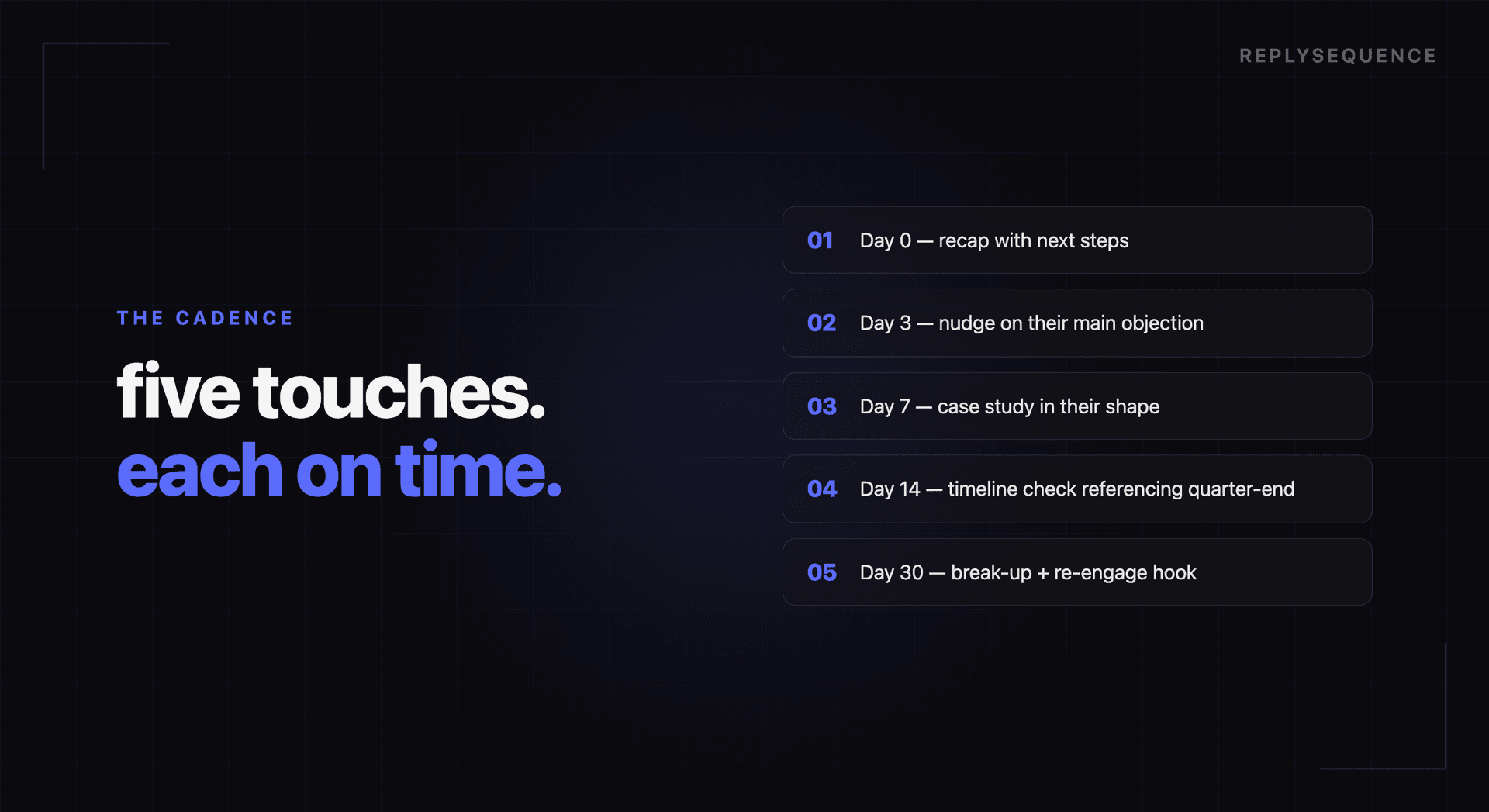
The ideal post-meeting email sequence length is 3 to 5 emails, sent over 10 to 14 days. That's not a guess: it's where the data clusters consistently across every study on sales follow-up effectiveness. One email isn't a sequence. Eight emails is harassment. The window between those two extremes is where deals actually close.
Most reps send one follow-up after a meeting. Maybe two. Then they go quiet and tell themselves the prospect will reach out when they're ready. They won't. 80% of sales require at least five follow-up touches after the first meeting, according to Marketing Donut. Meanwhile, 44% of reps give up after just one follow-up. That gap (between what it takes and what reps actually do) is where deals die in silence.
Why One Email Isn't Enough
Here's the thing about the post-meeting moment: your prospect just sat through back-to-back calls. By the time they read your follow-up, the specifics of your conversation are already blurring. One email doesn't give the idea time to settle. It doesn't account for the fact that buying decisions usually involve more than one person. And it definitely doesn't account for the chaos of a prospect's inbox.
A single follow-up email says "I showed up." A sequence says "I'm serious."
The goal of a post-meeting email sequence isn't to badger someone into buying. It's to stay present during the decision window, which, for most B2B SaaS deals, runs 1 to 3 weeks after the initial conversation. You're not chasing. You're closing the loop.
The 3-5 Email Framework (With Timing)
This is what actually works, based on what I've tested and what the research supports.
Email 1: Day 1: The Recap (Send Within 24 Hours)
This is the most important email in the sequence. Send it fast, within 2 hours of the meeting if you can, definitely within 24. It should recap what you discussed, confirm next steps, and attach anything you promised. Keep it tight. Five to seven sentences max.
This is where most reps burn the most time. Staring at a blank draft, trying to reconstruct a 45-minute conversation from memory. That's the exact problem I built ReplySequence to solve, paste your transcript, get a clean draft in 60 seconds.
Email 2: Day 3: The Value Add
Three days later, you send something useful. Not a "just checking in": that phrase should be deleted from sales vocabulary forever. Send a relevant case study. A short breakdown of how a similar company solved the same problem. A specific answer to an objection they raised in the meeting.
This email shows you were actually listening. It moves the conversation forward without asking for anything.
Email 3: Day 7: The Gentle Nudge
A week out, you check in, but with context. Reference the timeline they gave you. If they said they were evaluating options through end of month, acknowledge it. If they mentioned a board meeting, ask how it went. Personalization here isn't optional: it's the difference between a reply and a delete.
Keep it short. Two or three sentences. Make it easy to respond.
Email 4: Day 10: The Stakeholder Play
If you haven't heard back, this email addresses the real reason: there are other people involved. Offer to send materials their team can review. Offer a 15-minute call with whoever else needs to be in the room. You're not pressuring: you're removing friction.
This email often surfaces the real objection. Budget. Legal. A competing priority. That's valuable information, even if it's not the answer you wanted.
Email 5: Day 14: The Graceful Exit
If there's still no response after 14 days, you send a breakup email. Not passive-aggressive. Not dramatic. Something honest and low-pressure.
"Hey: I don't want to keep hitting your inbox if the timing's off. If this isn't the right moment, totally understand. Happy to reconnect whenever it makes sense."
This email gets responses. Regularly. People respect the out. And some of them take that moment to finally reply with what's actually going on.
When to Shorten or Extend the Sequence
The 3-5 framework is a default, not a law. Here's when to adjust.
Shorten to 2-3 emails when:
- The prospect gave you a clear timeline and said they'd follow up
- The deal is small and the decision is usually made fast
- You already have a warm relationship, over-sequencing feels weird here
- They explicitly asked you not to follow up more than once or twice
Extend to 6-7 emails when:
- The deal is large and involves multiple stakeholders
- There's a long procurement or legal process in play
- The prospect has gone dark but the meeting itself went genuinely well
- You're selling into a long sales cycle (90+ days) where nurture is expected
One thing I'll say: email sequence length matters less than email sequence quality. A 3-email sequence where every touch is specific, useful, and timely will outperform a 7-email sequence of generic check-ins every single time.
The Biggest Mistakes I See
The failures cluster around the same patterns.
Sending too late. The Day 1 email going out on Day 3 or 4. By then, the warmth from the meeting is gone. You're just another vendor in their inbox.
Being too vague. "Just wanted to follow up on our conversation" is not a follow-up. It tells the prospect nothing about why they should respond.
Front-loading the ask. Every email asks for a call, a decision, a signature. Space out the asks. The value-add emails exist precisely to earn the right to ask again.
Ignoring what was actually said in the meeting. This is the one that kills me. The prospect told you exactly what they care about, budget, timeline, a specific competitor they're evaluating. If your follow-up emails don't reference any of that, they read like they were written before the meeting even happened.
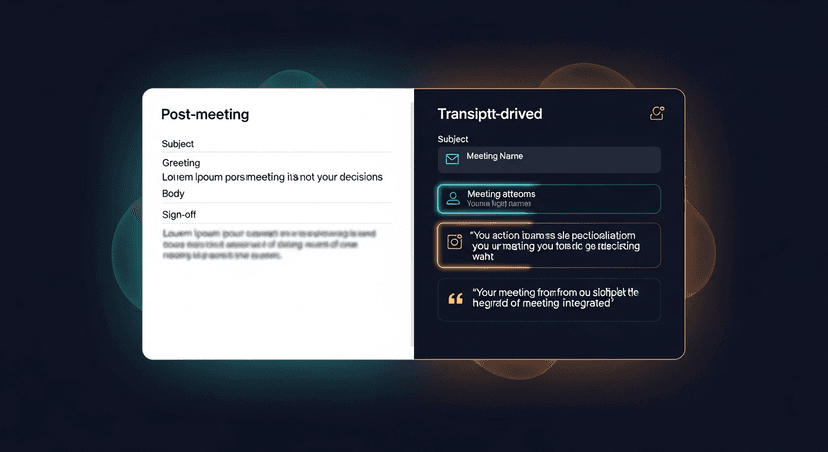
That last one is why transcript-driven follow-ups matter. When I built ReplySequence, the core idea was simple: if you start from the actual words spoken in the meeting, every email in the sequence is automatically more relevant. Transcript in, follow-up out. The meeting context doesn't get lost.
What About Sequence Duration: Days vs. Weeks?
Most post-meeting sequences should wrap up within 14 to 21 days. After three weeks with no response, you're past the active decision window for most deals. That doesn't mean the prospect is dead: it means they belong in a longer-term nurture cadence, not an active follow-up sequence.
The distinction matters. Active sequences have urgency and a clear goal: get a response, advance the deal, or get a clear no. Nurture is lower-frequency, longer-term relationship maintenance. Conflating the two leads to sequences that drag on for months and slowly turn a warm prospect cold.
A useful rule of thumb: if you haven't gotten a response after 5 touches over 14 days, move them to a monthly touch cadence and stop the active sequence.
The Bottom Line on Post-Meeting Email Sequence Length
Three to five emails. Ten to fourteen days. Day 1 recap, Day 3 value add, Day 7 nudge, Day 10 stakeholder play, Day 14 graceful exit. That's the framework. Adjust based on deal size, relationship warmth, and how the meeting actually went.
Post-meeting email sequence length isn't the hard part. The hard part is writing five good emails, per meeting, across a full pipeline, fast enough that the Day 1 email still lands while the conversation is fresh. That's the operational problem. That's what burns time and that's what makes reps default to one lazy follow-up instead of a real sequence.
If you're already using Fireflies, Otter, or Granola to transcribe your meetings, you're one step away from fixing this. Paste that transcript into ReplySequence and you've got a draft sequence in 60 seconds, personalized to what was actually said, ready to review and send. No bot in your meetings. No new tools to learn. Just the follow-up, handled.
Try it at replysequence.com.
Related reading
How ReplySequence handles this
ReplySequence takes any meeting transcript, paste it in from Zoom, Teams, Meet, WebEx, Fireflies, Granola, or wherever, and drafts a context-rich follow-up email in about 8 seconds. You review it, make any edits, and approve. Deal intelligence builds automatically.