Can AI Write Better Follow-Up Emails Than a Human?
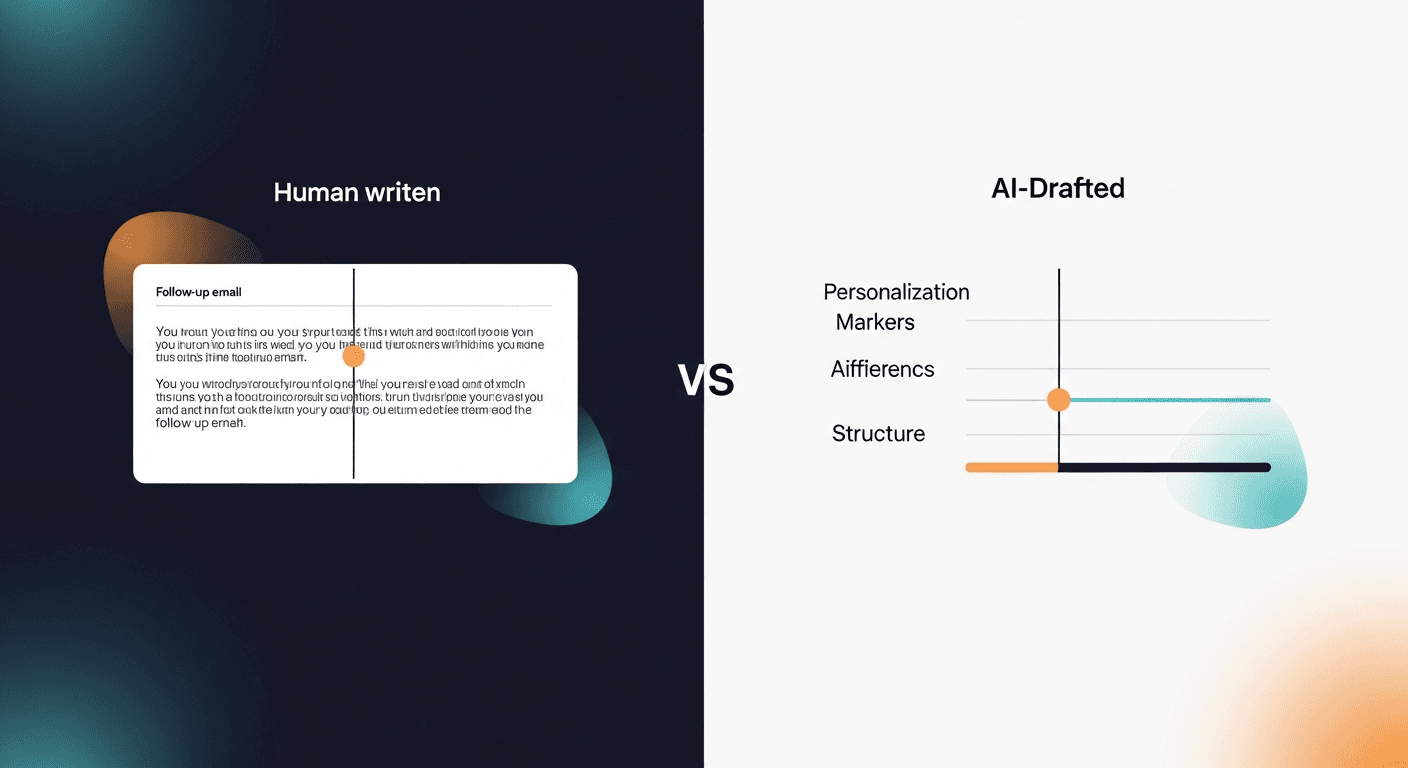
AI can write a follow-up email faster than any human. Whether it writes a better one depends on what you mean by better, and most of the debate skips that question entirely.
Here's the honest breakdown: raw speed and structure go to AI. Relationship nuance and earned trust still sit with humans. The teams winning right now aren't picking a side. They're using AI for the 80% and staying human for the 20% that closes deals.
What "Better" Actually Means in a Follow-Up Email
Before you run the comparison, you have to define the metric. A follow-up email can be graded on:
- Speed, how fast it gets sent after the meeting
- Accuracy, does it reflect what was actually discussed?
- Tone, does it sound like the sender, not a template?
- Structure, does it move the deal forward with clear next steps?
- Open and reply rates, does it actually work?
Humans and AI don't tie on all five. They trade off. Understanding where each wins is the whole ballgame.
Where AI Genuinely Wins
Speed: it's not close
The average rep waits 24-48 hours to send a follow-up email, according to research from HubSpot. By then, the buyer has moved on mentally. AI closes that gap to minutes. Paste a transcript from your Fireflies, Fathom, or Otter session, and you can have a structured follow-up in your drafts before the prospect finishes their next meeting.
Speed matters because timing is a proxy for professionalism. A follow-up sent within an hour signals that you were paying attention. A follow-up sent the next morning signals that writing it was a chore.
Consistency across volume
A rep sending two follow-ups a week can bring their full attention to each one. A rep running 8-10 discovery calls a week? By Thursday, those follow-ups are getting shorter, vaguer, and less useful. AI doesn't get fatigued. The eighth draft is as thorough as the first.
Structure and completeness
Good follow-up emails have a predictable anatomy: brief restatement of the problem discussed, recap of what was agreed, clear next step, and a low-friction call to action. Humans skip steps when they're rushed. AI, given a full transcript, hits all of them without being asked.
Research from Boomerang (analyzing millions of emails) found that emails between 50-125 words had the highest response rates. AI doesn't ramble. Humans often do.
Not going blank
Writer's block is real. "I don't know how to start this" costs reps 15-20 minutes per email. AI eliminates the blank page problem entirely: which is underrated as a productivity unlock.
ReplySequence does this automatically, paste any transcript, get a branded follow-up sequence back in 60 seconds.
Where Humans Still Win
Genuine relationship signals
AI reads the transcript. It doesn't read the room. It doesn't know that the prospect laughed when they mentioned their last vendor, or that there was an awkward pause when pricing came up, or that they mentioned their daughter's soccer tournament and it would mean something to reference it. Those signals don't make it into the transcript, and they're often what makes a follow-up feel like it came from a person, not a process.
Earned credibility and voice
The best salespeople have a distinctive writing voice. It's specific, a little off-script, and immediately recognizable. Generic AI output (the kind that starts with "It was great connecting with you today") flattens that voice. Recipients can feel the difference, even if they can't articulate it.
This is the problem I built voice-fingerprint to solve in ReplySequence. RS learns from your edits over time, so drafts start sounding like you instead of sounding like GPT defaults. But even with that, the initial training data has to come from actual human-written emails.
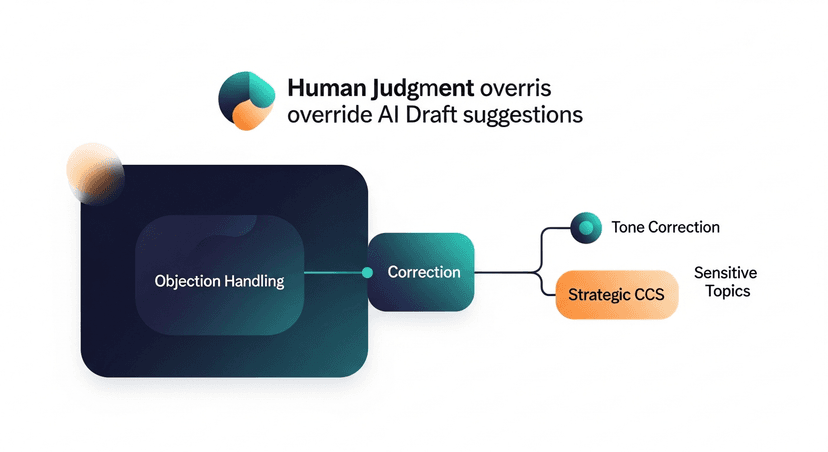
Strategic judgment calls
Should you address the pricing objection in the follow-up, or wait for the next call? Should you CC the champion's manager, or is that too aggressive? Should you lead with ROI or with risk reduction based on what you picked up in the meeting? These are judgment calls that require context AI doesn't have. A human rep who listened carefully makes better calls here.
Damage control
If the meeting went sideways (if you missed something, if there was tension, if you oversold) the recovery follow-up needs to be written by a human. Full stop. AI doesn't know what needs repairing.
The Real-World Test: Three Scenarios
Scenario 1: A solo founder running 6 discovery calls a week
They don't have an SDR. They're doing product, sales, and support simultaneously. By the time they sit down to write follow-ups, it's 8pm and the details are blurring together. AI draft from a Granola or Otter transcript? Near-essential. Human review before sending? Non-negotiable. That combo beats either approach alone.
Scenario 2: An AE at a 50-person SaaS company
They're using Fathom for transcription. After every call, they're supposed to update HubSpot, send a follow-up, and prep for the next call, in about 20 minutes. The follow-up consistently gets the least attention. AI handles the first draft. The AE tweaks two sentences, adds the personal callback they remember from the call, and sends. That's a better email than the one they would've written at 6pm when they finally had time.
Scenario 3: A recruiter after a candidate screen
They're sending 15-20 follow-ups a week across different roles and companies. The stakes are lower per email but the volume is brutal. AI first draft from the screen transcript keeps them consistent and professional. The recruiter adds one specific detail they remember, something the candidate said about why they're making a move. That one line is what the candidate remembers.
So Can AI Write Better Follow-Up Emails Than a Human?
For consistency, speed, completeness, and volume, yes. AI is objectively better in those dimensions.
For relationship nuance, voice authenticity, and strategic judgment, humans still win. Probably for a while.
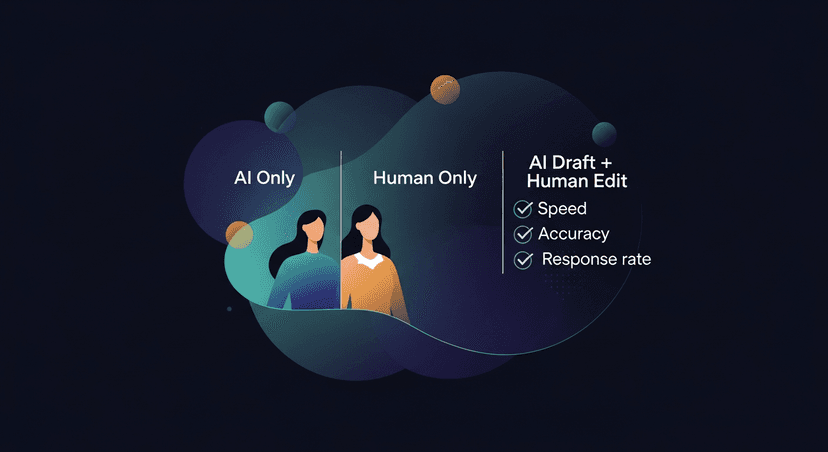
The framing of "AI vs. human" is the wrong question, honestly. The rep who uses AI to draft and then edits with human judgment will outperform the rep who writes from scratch and the rep who sends AI drafts without review. That middle path is where the actual edge is.
The follow-up email isn't the place to debate AI philosophy. It's the last mile of the sales conversation you just had. Get it sent fast, get it right, and make it sound like you.
The Practical Takeaway
If you're writing every follow-up from scratch, you're leaving speed on the table. If you're sending raw AI output without reading it, you're leaving trust on the table. The move is draft-first, human-reviewed, sent fast.
That's the workflow I built ReplySequence around. Transcript in, follow-up out, but always through your eyes before it hits send. The draft-first principle isn't a product limitation. It's the point.
—-
Start free at replysequence.com, 10 drafts a month, no credit card required. Pro is $29/mo if you want unlimited drafts, voice-fingerprint, and sequences. There's a 14-day Pro trial with no card required.
Get the weekly ReplySequence newsletter for more post-meeting follow-up tactics, subscribe at replysequence.com/newsletter.
Related reading
- Sales Follow-Up Automation: Balancing AI Efficiency with Human Touch
- AI vs Manual Follow-Up: Which Closes More Deals?
- How to Trust AI-Generated Follow-Up Emails (And When to Edit Them)
—-
What you should do next…
Depending on where you're at, here are three ways to keep going:
- Subscribe to the newsletter, weekly notes on sales follow-up workflows and the AI tooling that actually helps. No pitch.
- Try it with your own transcript, paste any meeting transcript, get a drafted follow-up in 30 seconds. No signup, no OAuth.
- Talk directly with Jimmy, 15-min intro or 30-min walkthrough. Founder-led, no sales team.
How ReplySequence handles this
ReplySequence takes any meeting transcript, paste it in from Zoom, Teams, Meet, WebEx, Fireflies, Granola, or wherever, and drafts a context-rich follow-up email in about 8 seconds. You review it, make any edits, and approve. Deal intelligence builds automatically.