 ReplySequence






BANT vs MEDDIC: Which Sales Qualification Framework Works Better?
```json
{
"title": "BANT vs MEDDIC: Which Sales Qualification Framework Works Better?",
"slug": "bant-vs-meddic-which-sales-qualification-framework-works-better",
"excerpt": "BANT is faster to run; MEDDIC wins on complex deals. Here's how to choose the right sales qualification framework for your pipeline.",
"content": "BANT vs MEDDIC qualification comes down to deal complexity. BANT (Budget, Authority, Need, Timeline) is a fast filter built for transactional sales. MEDDIC (Metrics, Economic Buyer, Decision Criteria, Decision Process, Identify Pain, Champion) is a deep-dive framework built for enterprise deals with multiple stakeholders and long cycles. Neither is universally better — but picking the wrong one for your motion will cost you deals.\n\nHere's how they actually compare, where each breaks, and how to choose.\n\n## What BANT Is (and Where It Came From)\n\nIBM invented BANT in the 1950s and 60s as an internal qualifier for reps to triage inbound leads fast. The four questions:\n\n- Budget — Does the prospect have money allocated for this?\n- Authority — Are you talking to the person who can sign?\n- Need — Do they have a real problem your product solves?\n- Timeline — When are they looking to buy?\n\nBANT is elegant in its simplicity. A rep can run through these four dimensions in the first 10 minutes of a discovery call and know whether to move forward or move on. That speed is the whole point.\n\nWhere BANT breaks down:\n\n- Budget conversations happen too early. Prospects routinely lie about budget — or don't know it yet — before they understand the value you're offering.\n- Authority is rarely binary. B2B purchases in 2026 involve an average of 6.8 stakeholders, according to Gartner research. "The decision-maker" is almost never one person.\n- Need is self-reported. BANT takes the prospect's word for it. If they've misdiagnosed their own problem, you're building on sand.\n- Timeline is aspirational. "Q3" usually means Q4, or never.\n\nBANT still works well for SMB, transactional deals under $10K, or high-volume inbound pipelines where speed of triage matters more than depth. A recruiter qualifying a hiring manager on a search retainer, or a SaaS AE running 15 discovery calls a week — BANT is fine there.\n\n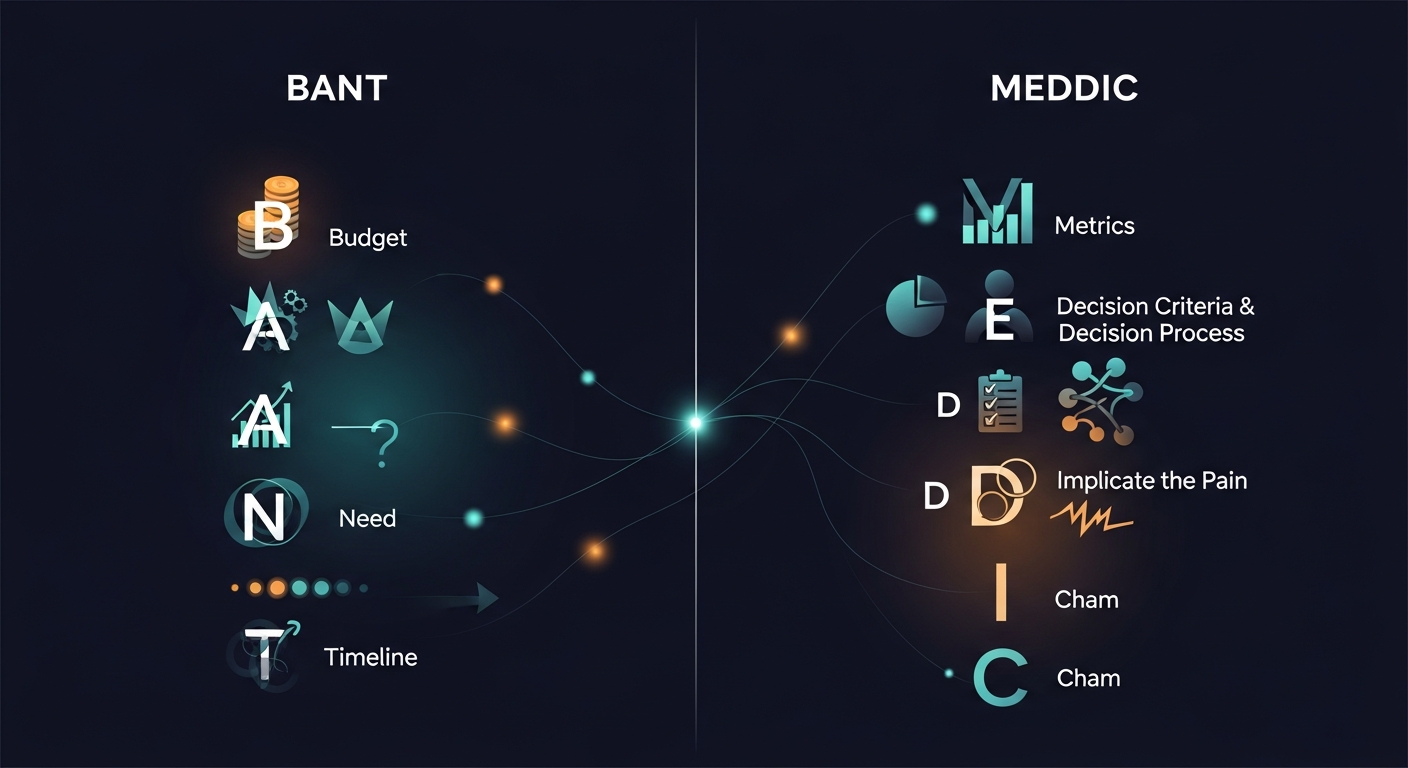 \n\n## What MEDDIC Is (and Where It Shines)\n\nMEDDIC was developed at PTC in the 1990s by Jack Napoli and Dick Dunkel. PTC went from $300M to $1B in revenue while using it. That's the origin story everyone cites — and it's legitimate.\n\nThe six components:\n\n- Metrics — What's the quantifiable impact of solving this problem? (revenue gain, time saved, cost reduced)\n- Economic Buyer — Who controls the budget and has final authority? Not who you're talking to — who can write the check.\n- Decision Criteria — What does the prospect use to evaluate solutions? Technical fit, vendor stability, price, integrations?\n- Decision Process — What are the steps, who's involved, and what's the sequence to get a signed contract?\n- Identify Pain — What's the explicit, business-critical pain driving urgency? Not feature requests — actual consequences of not solving it.\n- Champion — Who inside the account wants you to win and has internal credibility to sell for you?\n\nMEDDIC forces you to earn your deal understanding rather than accept surface-level answers. You're not asking "do you have budget?" — you're building a business case around Metrics that makes budget approval inevitable. You're not assuming one decision-maker — you're mapping the entire Decision Process.\n\nWhere MEDDIC breaks down:\n\n- It's slow. Running a full MEDDIC qualification takes multiple conversations and significant research. For a $500/month SaaS deal, that's ROI-negative.\n- It requires rep discipline and training. BANT a junior rep can grasp in an afternoon. MEDDIC takes months to internalize, and most reps short-circuit it under quota pressure.\n- Not all deals have a Champion to find. In very early-stage markets or with completely new categories, internal advocates may not exist yet.\n\nMEDDIC wins on deals above $25K ACV, enterprise software, anything with procurement involvement, multi-stakeholder committee buys, or competitive deals where being technically better isn't enough.\n\nReplySequence does this automatically — paste any transcript from your discovery call, get a branded follow-up sequence back in 60 seconds, with the key pain points and next steps already surfaced.\n\n
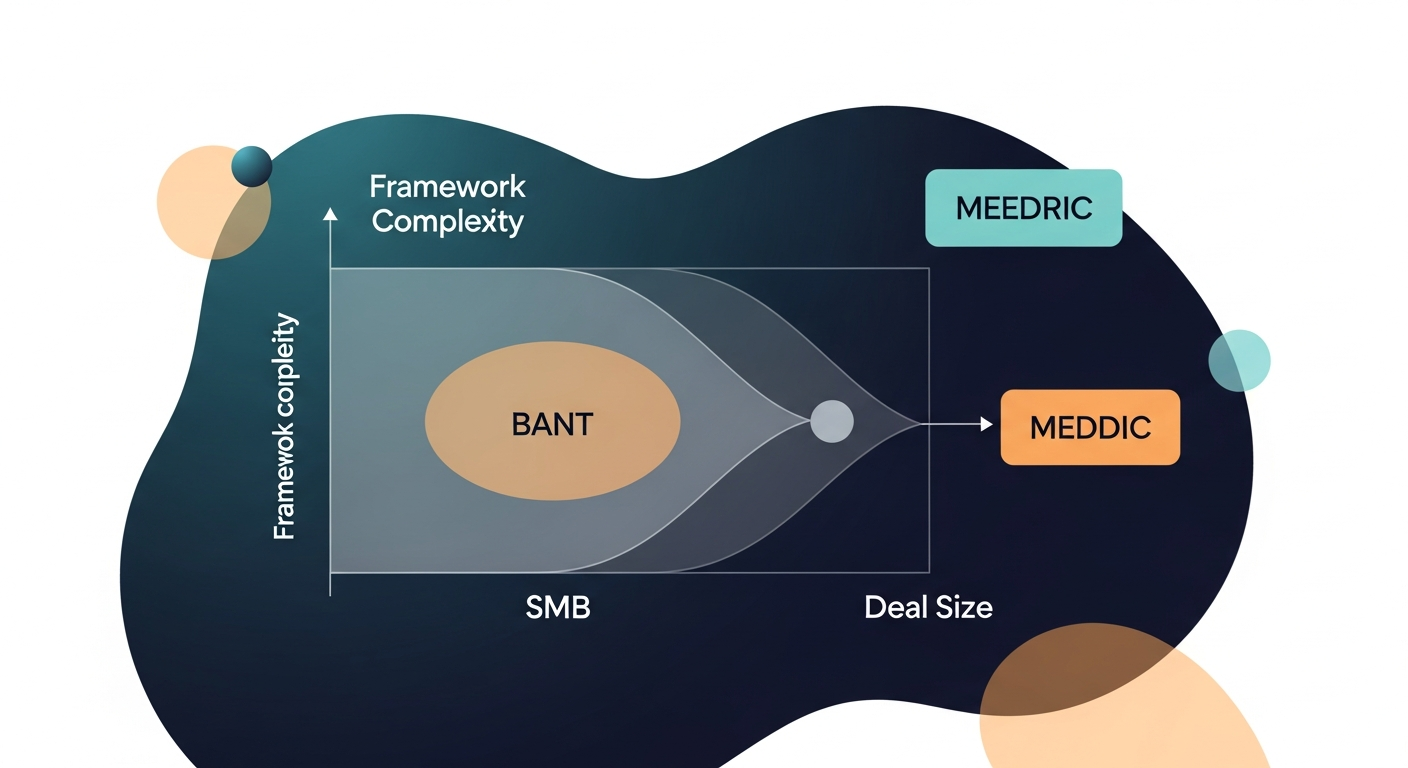 \n\n## BANT vs MEDDIC: Direct Comparison\n\nInstead of a table (they never render right), here's the head-to-head broken down by the dimensions that actually matter:\n\nSpeed of qualification:\nBANT wins. One call, four questions. MEDDIC requires multiple touchpoints to fully validate.\n\nAccuracy on complex deals:\nMEDDIC wins by a wide margin. It explicitly accounts for stakeholder complexity, internal politics, and the champion dynamic that BANT ignores entirely.\n\nRamp time for new reps:\nBANT wins. Simple acronym, intuitive logic. MEDDIC requires coaching, role-play, and repetition to land properly.\n\nForecast reliability:\nMEDDIC wins. A deal that's been fully MEDDIC'd — with a confirmed Champion, mapped Decision Process, and validated Economic Buyer — is dramatically more predictable than a BANT-qualified deal where you've only spoken to your main contact.\n\nFit for inbound, high-velocity pipelines:\nBANT wins. When you're running 10+ discovery calls a week, MEDDIC overhead kills throughput.\n\nFit for outbound, enterprise, or long-cycle deals:\nMEDDIC wins. The framework is essentially a checklist for the exact failure modes that kill enterprise deals — lack of a champion, surprise competitors, procurement coming in late, economic buyer never engaged.\n\nApplicability to founder-led or consultant sales:\nHybrid approach wins (more on this below). Solo founders and consultants often have the depth of MEDDIC's intent but need BANT's speed — especially early-stage when deal volume is low and every call counts.\n\n## The Hybrid Approach Most Teams Actually Use\n\nHere's the practical reality: most revenue teams don't use BANT or MEDDIC in pure form. They blend them.\n\nA common hybrid pattern I see documented across sales methodologies:\n\n- Use BANT for initial triage (first call, or even pre-call research). Is there a genuine need and rough budget range? Is your contact in the vicinity of authority? Is there a real timeline or just curiosity?\n- Layer MEDDIC as the deal progresses into multi-stakeholder territory. Once you know it's a real opportunity, start building your Metrics story, finding your Champion, mapping the Decision Process.\n\nThis works because BANT tells you whether to invest MEDDIC depth. MEDDIC tells you how to close what BANT surfaced.\n\nScenario: a solo founder running discovery calls for a B2B SaaS product\n\nFirst call: lightweight BANT. Is this company the right size? Does this person have budget authority or are they a researcher? Do they have the problem I solve, or a cousin of it? Are they evaluating now or in 18 months?\n\nIf yes to most of those — second call goes MEDDIC-mode. What's the cost of their current problem in hard numbers? Who else is in the room when this decision gets made? What does "winning" look like internally for the person I'm talking to?\n\nScenario: a recruiter qualifying a new client on a retained search\n\nBANT is probably enough. Is there a real role? Do they have budget for retained fees? Am I talking to the hiring manager or HR? When do they need someone in seat? If all four check out, move to proposal. The deal cycle is short enough that MEDDIC overhead isn't worth it.\n\nScenario: an AE at a 50-person software company selling $40K+ annual contracts\n\nMEDDIC, full stop. The deal complexity demands it. Missing the Economic Buyer or failing to build a Champion is how you lose deals you should have won at the finish line — after months of work.\n\n
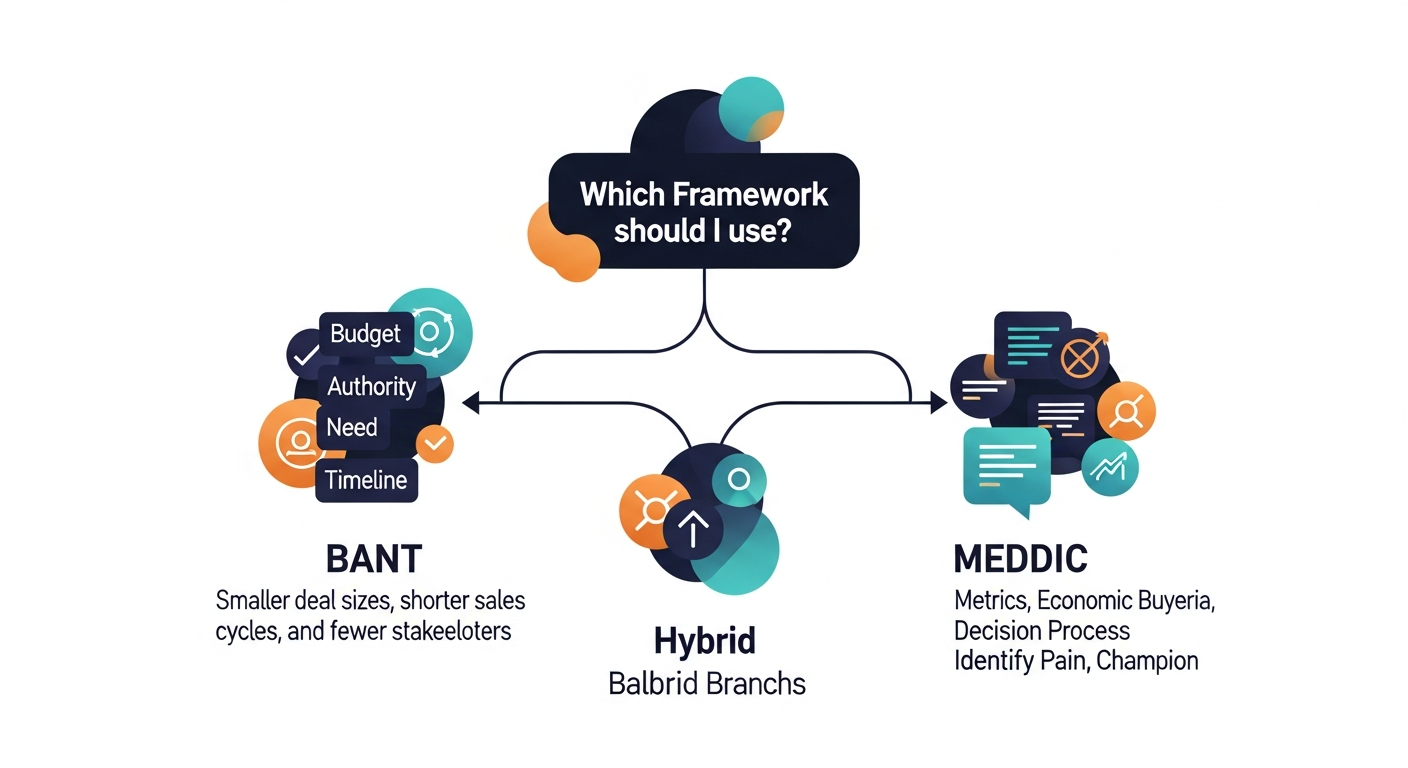 \n\n## The Follow-Up Problem Neither Framework Solves\n\nHere's something worth calling out: BANT and MEDDIC are both qualification frameworks. They tell you what to ask and what to learn. Neither of them does anything about what happens after the call ends.\n\nAnd that's where deals actually die. Research from Yesware found that 70% of email chains stop after a single unanswered message — but 70% of deals require at least 5 follow-up touches. The qualification was solid. The follow-up just... didn't happen, or happened too slowly, or sounded like a generic template that ignored everything discussed in the call.\n\nIf you're running MEDDIC and you've done the hard work of surfacing Metrics and finding a Champion, your follow-up email should reflect that. It should reference the specific pain, the quantified business impact, the next step in the Decision Process you mapped together. A generic "just checking in" email after a MEDDIC discovery call is a waste of everything you just built.\n\nThat's the gap I built ReplySequence to close. After Fireflies, Fathom, Granola, Otter, or any recorder does the transcription — paste the transcript, and you get a follow-up sequence that reflects the actual conversation: the pain points, the stakeholders, the timeline, the next steps. Transcript in, follow-up out. The framework is yours. The follow-up doesn't have to be a bottleneck.\n\n## Which Framework Should You Actually Use?\n\nQuick decision guide:\n\n- BANT if: deals are under $10K ACV, sales cycle is under 30 days, you're handling high-volume inbound, or you're doing initial triage before investing deeper\n- MEDDIC if: deals are $25K+ ACV, there are 3+ stakeholders involved, you're in a competitive evaluation, or your close rate is suffering despite good discovery conversations\n- Hybrid (BANT first, MEDDIC layered in) if: you're a solo founder or small team running a mix of deal sizes, or you're in a growth-stage company formalizing sales process for the first time\n\nThe framework is a map. The territory is your specific market, your buyer, your deal size. Neither BANT nor MEDDIC will save bad product-market fit or a rep who stops following up after one email.\n\nStart with what matches your current deal complexity. Upgrade the framework when your deal complexity demands it.\n\n—-\n\nIf you're already running BANT or MEDDIC calls and losing time writing follow-ups afterward — start free at replysequence.com. Ten drafts a month, no credit card required. Paste any transcript, get a branded follow-up sequence back in 60 seconds.\n\nGet the weekly ReplySequence newsletter for more post-meeting follow-up tactics — subscribe at replysequence.com/newsletter.",
"date": "2026-04-27",
"author": "Jimmy Hackett",
"tags": ["sales qualification", "BANT framework", "MEDDIC", "sales process", "discovery calls"],
"readingTime": 8,
"faqs": [
{
"question": "What is the main difference between BANT and MEDDIC qualification?",
"answer": "BANT (Budget, Authority, Need, Timeline) is a fast four-question framework built for transactional, high-volume sales. MEDDIC (Metrics, Economic Buyer, Decision Criteria, Decision Process, Identify Pain, Champion) is a deeper framework built for complex enterprise deals with multiple stakeholders. BANT prioritizes speed; MEDDIC prioritizes forecast accuracy and deal control."
},
{
"question": "When should I use BANT instead of MEDDIC?",
"answer": "Use BANT when deals are under $10K ACV, sales cycles are short (under 30 days), or you're triaging high-volume inbound leads. It's also effective for recruiters, consultants, and SMB reps who need to qualify quickly without deep stakeholder mapping."
},
{
"question": "When should I use MEDDIC instead of BANT?",
"answer": "Use MEDDIC when deals are $25K+ ACV, involve three or more stakeholders, or have a long competitive evaluation cycle. MEDDIC is especially valuable when deals are being lost late in the process despite good initial discovery."
},
{
"question": "Can I use BANT and MEDDIC together?",
"answer": "Yes — many teams use a hybrid approach. BANT is used for initial triage to determine whether a deal is worth deeper investment, then MEDDIC is layered in as the opportunity develops and stakeholder complexity increases."
},
{
"question": "Does BANT or MEDDIC help with post-meeting follow-up?",
"answer": "Neither framework addresses what happens after the call. Both BANT and MEDDIC are qualification methodologies — they guide what to ask, not how to follow up. Writing a follow-up that reflects the specific pain, metrics, and next steps discovered in the call is a separate problem, and it's where many deals stall."
}
],
"jsonLd": "{\"@context\":\"https://schema.org\",\"@type\":\"FAQPage\",\"mainEntity\":[{\"@type\":\"Question\",\"name\":\"What is the main difference between BANT and MEDDIC qualification?\",\"acceptedAnswer\":{\"@type\":\"Answer\",\"text\":\"BANT (Budget, Authority, Need, Timeline) is a fast four-question framework built for transactional, high-volume sales. MEDDIC (Metrics, Economic Buyer, Decision Criteria, Decision Process, Identify Pain, Champion) is a deeper framework built for complex enterprise deals with multiple stakeholders. BANT prioritizes speed; MEDDIC prioritizes forecast accuracy and deal control.\"}},{\"@type\":\"Question\",\"name\":\"When should I use BANT instead of MEDDIC?\",\"acceptedAnswer\":{\"@type\":\"Answer\",\"text\":\"Use BANT when deals are under $10K ACV, sales cycles are short (under 30 days), or you're triaging high-volume inbound leads. It's also effective for recruiters, consultants, and SMB reps who need to qualify quickly without deep stakeholder mapping.\"}},{\"@type\":\"Question\",\"name\":\"When should I use MEDDIC instead of BANT?\",\"acceptedAnswer\":{\"@type\":\"Answer\",\"text\":\"Use MEDDIC when deals are $25K+ ACV, involve three or more stakeholders, or have a long competitive evaluation cycle. MEDDIC is especially valuable when deals are being lost late in the process despite good initial discovery.\"}},{\"@type\":\"Question\",\"name\":\"Can I use BANT and MEDDIC together?\",\"acceptedAnswer\":{\"@type\":\"Answer\",\"text\":\"Yes — many teams use a hybrid approach. BANT is used for initial triage to determine whether a deal is worth deeper investment, then MEDDIC is layered in as the opportunity develops and stakeholder complexity increases.\"}},{\"@type\":\"Question\",\"name\":\"Does BANT or MEDDIC help with post-meeting follow-up?\",\"acceptedAnswer\":{\"@type\":\"Answer\",\"text\":\"Neither framework addresses what happens after the call. Both BANT and MEDDIC are qualification methodologies — they guide what to ask, not how to follow up. Writing a follow-up that reflects the specific pain, metrics, and next steps discovered in the call is a separate problem, and it's where many deals stall.\"}}]}"
}
```
—-
What you should do next…
Depending on where you're at, here are three ways to keep going:
- Grab the free playbook — "The 8-Second Follow-Up Playbook" lands in your inbox. You'll also get Close The Loop, weekly notes on post-meeting follow-up (unsubscribe anytime, no pitch).
- Try it with your own transcript — paste any meeting transcript, get a drafted follow-up in 30 seconds. No signup, no OAuth.
- Talk directly with Jimmy — 15-min intro or 30-min walkthrough. Founder-led, no sales team.
How ReplySequence handles this
ReplySequence takes any meeting transcript — paste it in from Zoom, Teams, Meet, WebEx, Fireflies, Granola, or wherever — and drafts a context-rich follow-up email in about 8 seconds. You review it, make any edits, and approve. Deal intelligence builds automatically.