Challenger Sale Method: Post-Meeting Follow-Up Guide
The Challenger Sale post-meeting follow-up isn't a thank-you note. It's a teaching moment: a second chance to reframe the problem, tailor the insight to the specific stakeholder, and take commercial control before the prospect's attention drifts elsewhere.
Most reps treat the follow-up as an administrative task. Challenger reps treat it as a sales move. That gap is where deals are won or lost.
What the Challenger Sale Method Actually Means (and Why Follow-Up Is Where It Gets Dropped)
The Challenger Sale, introduced by Matthew Dixon and Brent Adamson in their 2011 CEB research study, identified five seller profiles. The Challenger (the rep who teaches, tailors, and takes control) closed dramatically more complex deals than the others. The research found Challenger reps represented 40% of high performers in complex B2B sales, despite being just one of five identified profiles.
The three core moves of the Challenger method are:
- Teach, Offer a commercial insight the prospect hasn't considered. Not product features. A reframe of their business problem.
- Tailor, Adapt that insight to the specific stakeholder's priorities, not a generic pitch deck.
- Take Control, Drive the buying process. Handle pushback. Keep momentum.
Here's the problem: most Challenger-trained reps execute these moves in the meeting and then send a follow-up that reads like a meeting summary from 1998. "Great talking today. Here's what we discussed. Let me know if you have questions."
The commercial insight evaporates. The tailoring disappears. Control of the deal passes to the prospect's inbox clutter.
The post-meeting follow-up is the fourth Challenger move. It just hasn't been named yet.

How to Teach in Your Follow-Up Email
A Challenger follow-up opens with insight, not recap. The prospect knows what happened in the meeting. They don't need a bullet list of topics covered. They need the so what: the reframe that was the point of the whole conversation.
Here's how to structure the teaching move in written form:
- Lead with the commercial insight, not the agenda recap. Start with the tension you surfaced. "Most [industry] teams are optimizing for [X], but the data suggests [Y] is actually the bigger lever." One or two sentences. No preamble.
- Anchor it to something they said. Pull a specific phrase or concern from the meeting. "When you mentioned [specific challenge], that's exactly where this plays out." This proves you were listening and makes the insight feel earned, not generic.
- Connect the insight to a consequence. What happens if they keep doing things the way they're doing them? Make the cost of inaction visible. Industry research helps here: a relevant stat from Gartner, McKinsey, or HBR lands harder than your opinion.
- Resist the urge to list your features. The teaching move is about their world, not your product. The product shows up later, briefly, as the logical solution to the problem you just made visible.
A solo founder running discovery calls with enterprise buyers, for example, might use the follow-up to share a benchmark ("companies at your ARR stage typically lose 15-20% of renewal revenue to churn driven by [specific trigger]") and then connect it directly to the workflow problem they discussed. That's teaching. Sending a one-pager PDF attachment is not.
How to Tailor the Follow-Up to the Right Stakeholder
This is where most Challenger attempts collapse in writing. Tailoring in a meeting is intuitive: you read the room, adjust your language, emphasize what resonates. In a follow-up email, you have to make deliberate choices.
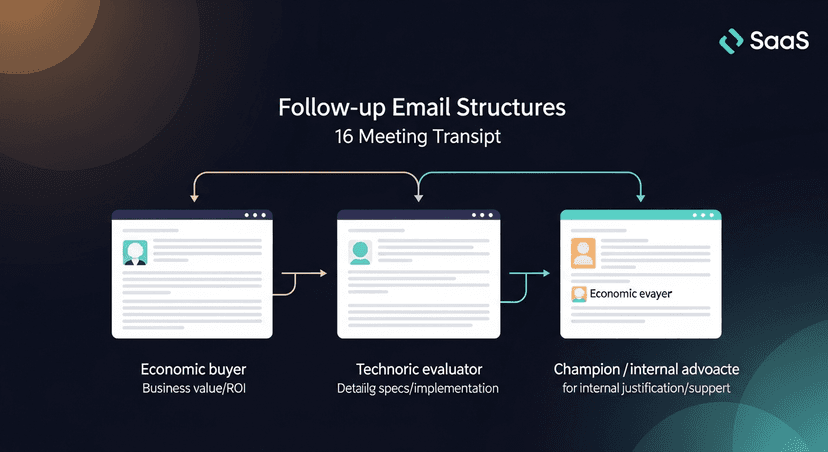
Tailoring means writing a different email for the economic buyer than you write for the technical evaluator who was also in the room.
For the economic buyer (VP, C-Suite):
- Lead with revenue impact or risk, not process details
- Keep it short: three paragraphs max
- The insight should tie to a board-level priority they've signaled
- The ask should be crisp and specific: a decision, a next call, an intro to another stakeholder
For the technical evaluator or champion:
- You can go deeper on the mechanism
- Acknowledge the implementation questions they raised
- Frame your product's role in solving the specific workflow friction they described
- Give them something they can forward internally: a one-sentence summary that makes them look smart
For the skeptic in the room (and there's always one):
- Address their objection directly in the email, don't dance around it
- Challenger reps take control of the pushback; Challenger follow-ups do the same in writing
- "I noticed [concern] came up a few times, here's how other [role]s have thought through it"
ReplySequence does this automatically, paste any transcript, get a branded follow-up sequence back in 60 seconds.
How to Take Commercial Control in Writing
Taking control in a live conversation is one thing. Taking control in an async email requires a different technique. Here's what it looks like:
Set the timeline explicitly. Don't end with "let me know when works for you." End with "I'm holding time on [specific date], does that work, or is [alternate date] better?" Challenger reps remove optionality from next steps. Your follow-up should do the same.
Name the decision. What needs to happen before the next meeting? Who else needs to be in the room? Make this visible: "Based on what you described, the [budget/technical/security] review would typically involve [person or team]. Worth looping them in now rather than at the end."
Preempt the stall. Deals stall because the prospect hits internal friction that was predictable. A Challenger follow-up addresses that friction before it surfaces: "The question that usually comes up at this stage is [X], here's how I'd frame it for your CFO."
One ask, clearly stated. Every Challenger follow-up should have a single, unambiguous next step. Not three options. Not "feel free to reach out." One ask. Confirm the next meeting, share the evaluation doc, or make the intro. Pick one.
A recruiter following up after a hiring manager screen, for example, isn't just summarizing the conversation: they're taking control of the timeline, naming the next decision point (offer approval, panel scheduling, comp alignment), and removing ambiguity about who owns what action. Same structure, different context.
The Challenger Follow-Up Email Structure (In Practice)
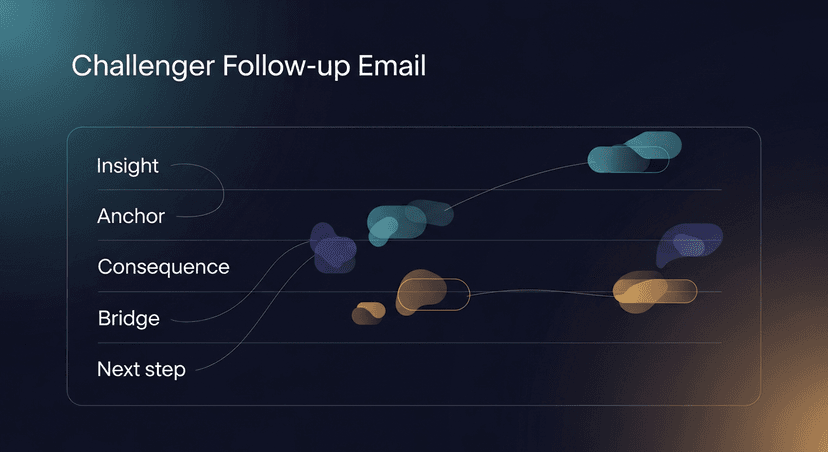
Put it together and a Challenger sale post-meeting follow-up looks like this:
- Subject line: Reference the specific insight or tension, not the meeting. "The [problem] gap we talked through" beats "Follow-up from our call."
- Opening (1-2 sentences): Lead with the commercial insight. No pleasantries, no recap.
- Anchor (1-2 sentences): Tie the insight to something they said verbatim.
- Consequence (1-2 sentences): What's the cost of the status quo? One stat or benchmark if you have one.
- Bridge to solution (1-2 sentences): Brief, specific. Not a feature list.
- Next step (1 sentence): One clear ask. Specific date or decision.
- Optional: stakeholder-specific add-on for the champion, something they can forward.
Total length: 200-300 words. Short enough to read in 60 seconds. Dense enough to move the deal.
Why the Follow-Up Is the Last Mile of Challenger Selling
The Challenger method was built around the idea that insight (not relationship) is the engine of complex B2B sales. Dixon and Adamson's research showed that "solution selling" was dead in environments where buyers were 57% through their decision process before engaging a rep (CEB, 2011, widely cited, though the exact number has been debated and updated across subsequent studies).
If the insight move is that critical, leaving it on the meeting floor is a strategic error. The follow-up is the rep's second shot at the insight, delivered in writing, tailored to the right person, at the moment the prospect is synthesizing what they heard and deciding whether to keep moving.
That's why I built ReplySequence around the transcript, not the calendar. You bring whatever transcript you have (Fireflies, Otter, Fathom, Granola, a pasted summary from your notes) and the tool turns it into a structured follow-up sequence that reflects your voice and your read of the meeting. Not a generic GPT summary. A Challenger-structured follow-up that teaches, tailors, and takes control, in the 60 seconds after the call ends.
The meeting went great. Make sure the follow-up doesn't undo it.
—-
Start free at replysequence.com, 10 drafts per month, no credit card required. If you're running unlimited post-meeting follow-ups, Pro is $29/mo with voice-fingerprint and sequences included.
Get the weekly ReplySequence newsletter for more post-meeting follow-up tactics, subscribe at replysequence.com/newsletter.
Related reading
- Follow-Up Emails That Create Urgency Without Pressure
- Close Open Loops From Sales Calls Before They Kill Your Deal
- How to Automate Meeting Follow-Up Emails
—-
What you should do next…
Depending on where you're at, here are three ways to keep going:
- Grab the free playbook, "The 8-Second Follow-Up Playbook" lands in your inbox. You'll also get Close The Loop, weekly notes on post-meeting follow-up (unsubscribe anytime, no pitch).
- Try it with your own transcript, paste any meeting transcript, get a drafted follow-up in 30 seconds. No signup, no OAuth.
- Talk directly with Jimmy, 15-min intro or 30-min walkthrough. Founder-led, no sales team.
How ReplySequence handles this
ReplySequence takes any meeting transcript, paste it in from Zoom, Teams, Meet, WebEx, Fireflies, Granola, or wherever, and drafts a context-rich follow-up email in about 8 seconds. You review it, make any edits, and approve. Deal intelligence builds automatically.