Recap a Discovery Call to Move Prospects Forward
The best way to recap a discovery call and move the deal forward is to send a structured follow-up email within 60 minutes of hanging up: one that mirrors the prospect's own words back to them, confirms next steps, and gives them a reason to reply. Not a summary of what you talked about. A document of shared understanding.
Most discovery calls die in the follow-up gap. The call felt great. Then nothing happened.
Why Discovery Call Recaps Usually Fail
The problem isn't that reps skip the recap. Most send something. The problem is what they send.
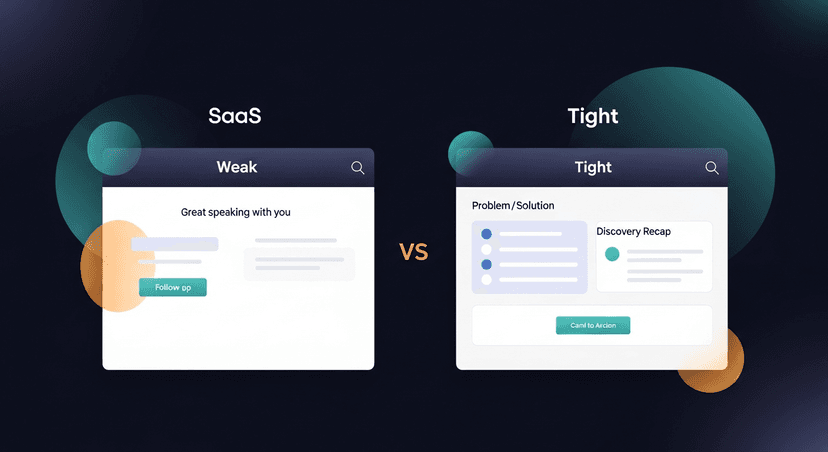
Typical discovery follow-ups look like this:
- "Great speaking with you today!"
- A vague sentence about what was discussed
- "Let me know if you have any questions"
- A calendar link buried at the bottom
That's not a recap. That's a paper trail. It doesn't move anything forward because it doesn't ask the prospect to do anything specific, and it doesn't reflect back the specific pain they articulated on the call.
Research from HubSpot consistently shows that 80% of sales require five or more follow-up touches, yet 44% of reps give up after one. A weak first follow-up is a wasted touch, and in discovery, you can't afford wasted touches.
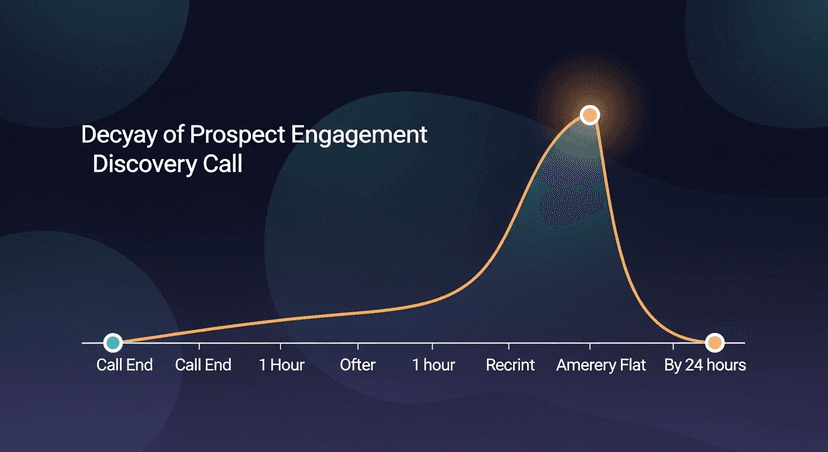
The other common failure: timing. A recap that lands 24 or 48 hours after the call is cold. The prospect has moved on to twelve other things. The emotional high of a good conversation has faded. You're starting from scratch.
What a Good Discovery Call Recap Actually Includes
Here's what separates a recap that advances the deal from one that doesn't.
1. Their words, not yours
The single most powerful thing you can do in a discovery recap is quote the prospect back to themselves. If they said "our biggest problem right now is that deals are slipping between the demo and the close," that phrase belongs in your email. Verbatim.
This does two things. It proves you were listening. And it forces them to re-engage with the problem they described, in their own language, not yours.
This is also why timing matters. The sooner you send the recap, the more accurate your recall of their specific phrasing. Wait 24 hours and you're paraphrasing. Paraphrasing is generic. Generic doesn't move deals.
2. A crisp problem/solution frame
After you've reflected their situation back, bridge to why it matters:
- What they told you the problem is (their words)
- What happens if it stays unsolved (cost of inaction, ideally something they mentioned)
- What the next step looks like (specific, time-bound, mutual)
Don't try to close in the recap. The goal is to get them to a next meeting, not a signature. Keep the frame tight.
3. Concrete next steps with a deadline
"Following up soon" is not a next step. A next step is:
- "I'm holding Tuesday at 2pm ET for our demo, does that still work?"
- "Can you loop in your IT lead by Thursday so we can scope the integration?"
- "I'll send the proposal by Friday, does your procurement team need anything specific in the format?"
Every discovery recap should have exactly one ask. One. Multiple asks give prospects permission to address none of them.
4. Short. Always short.
A discovery recap is not a meeting summary document. It's not a Word doc with headers and bullet sections. It's a professional email that a busy person can read in 90 seconds and reply to in 30.
Target length: 150-250 words. If you're going over 300, you're summarizing for your own benefit, not theirs.
ReplySequence does this automatically, paste any transcript, get a branded follow-up sequence back in 60 seconds.
The 60-Minute Rule
Send the recap within 60 minutes of the call ending. That's the window.
This isn't arbitrary. A few things happen in that window:
- Your notes are fresh. You can pull specific phrases they used without digging through a transcript.
- The prospect is still in context. They haven't mentally closed the loop on your conversation yet.
- Speed signals something. Responding fast (not desperate fast, but on top of it fast) communicates that you run a tight process. That's a proxy signal for how you'll treat them as a customer.
The 60-minute rule is hard to hit when you're writing from scratch. That's why the best reps have a template with blanks to fill in, or use tooling that does the draft for them the moment the transcript is available.
How to hit 60 minutes without losing quality
Here's the actual workflow that works:
- During the call, jot 3-5 exact phrases the prospect uses to describe their pain. Don't try to take full notes. Just grab the good language.
- Immediately after (paste your transcript (from Fireflies, Fathom, Granola, Otter, Zoom, Teams) whatever you're using) into your follow-up tool. Let it do the heavy lifting on structure.
- Edit for accuracy, review the draft, verify the next steps match what was actually agreed, swap in any specific language the tool missed.
- Send before you do anything else, before Slack, before lunch, before the next call. Send it.
This is the discipline that separates reps who consistently advance deals from the ones who wonder why discovery calls don't convert.
What to Do When There's No Clear Next Step
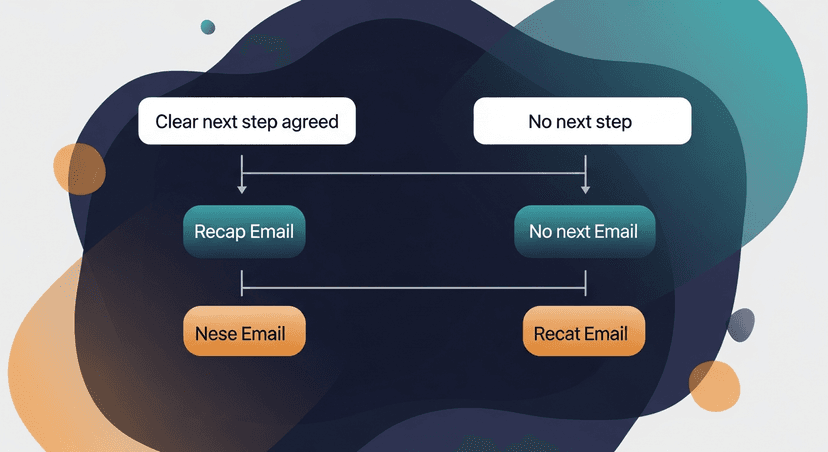
Sometimes a discovery call ends without a firm next step agreed. The prospect said "I'll have to think about it" or "let me check with my partner." You can still send a strong recap.
The approach:
- Reflect the problem/situation back
- Name the ambiguity directly: "I know you wanted to loop in [name] before committing to a next step"
- Give them a specific, low-friction option: "I'll follow up Thursday, or if it's easier, here's a link to grab 30 minutes whenever works"
- Don't over-apologize for the lack of clarity. Stay confident.
The goal of the recap in this scenario isn't to manufacture urgency. It's to stay top of mind and give them the path of least resistance to move forward.
A Discovery Recap Template (Steal This)
Here's a stripped-down structure you can adapt:
Subject: Quick recap, [Company] / [Your Company]
Opening line (their situation, their words):
"You mentioned that [specific quote or close paraphrase of their pain], and that this was costing [time/money/deals/whatever they said]."
Bridge:
"Based on what you shared, [solution/approach] looks like the right fit because [specific reason tied to their situation]."
Next step (single, specific, time-bound):
"I've blocked [day/time] for our next call, does that work, or would [alternate time] be better?"
Closing (one line, no fluff):
"Looking forward to it, let me know if anything changes before then."
No "hope you're doing well." No "please don't hesitate to reach out." Just signal, structure, ask.
The Follow-Up Sequence After Discovery
The recap is touch one. If they don't reply within 48 hours, you need a sequence: not a single nudge.
A three-touch sequence after discovery typically looks like:
- Day 1: The recap email (structure above)
- Day 3: A value-add follow-up: a relevant resource, a case study (if you have one), or a specific insight from the call that you've thought more about
- Day 7: A direct check-in, short, no fluff, just "Still worth connecting this week?"
The goal of the sequence is to stay relevant, not to be annoying. Each touch should add something: a question, a resource, a new angle. Not just "following up on my last email."
Teams priced out of HubSpot Sales Hub Pro (which runs $450+/month per seat at the minimum tier) often skip sequences entirely because the tooling feels out of reach. That's a gap I built ReplySequence to close, sequences without the enterprise CRM tax.
The Recap Discovery Call Mindset Shift
Stop thinking of the discovery recap as a formality. It's not something you send to check a box. It's the first test of whether this deal has legs.
A strong recap says: I heard you, I understand your situation, here's what happens next. That's the whole job. Get it right and you create momentum. Skip it or phone it in and you're starting the next call at zero.
The meeting went great. Don't let that be where the deal stops.
—-
Start free at replysequence.com, 10 drafts/month, no credit card required. Paste any transcript from Fireflies, Fathom, Otter, Granola, or wherever you record, and get a branded discovery recap back in 60 seconds. The Pro trial is 14 days, no card needed.
Get the weekly ReplySequence newsletter for more post-meeting follow-up tactics, subscribe at replysequence.com/newsletter.
Related reading
- How to Recap a Discovery Call to Move Prospects Forward
- How to Write a Sales Follow-Up Email After a Meeting (With Templates)
- How Consultants Should Follow Up After Client Discovery Calls
—-
What you should do next…
Depending on where you're at, here are three ways to keep going:
- Grab the free playbook, "The 8-Second Follow-Up Playbook" lands in your inbox. You'll also get Close The Loop, weekly notes on post-meeting follow-up (unsubscribe anytime, no pitch).
- Try it with your own transcript, paste any meeting transcript, get a drafted follow-up in 30 seconds. No signup, no OAuth.
- Talk directly with Jimmy, 15-min intro or 30-min walkthrough. Founder-led, no sales team.
How ReplySequence handles this
ReplySequence takes any meeting transcript, paste it in from Zoom, Teams, Meet, WebEx, Fireflies, Granola, or wherever, and drafts a context-rich follow-up email in about 8 seconds. You review it, make any edits, and approve. Deal intelligence builds automatically.