Follow-Up Emails That Create Urgency Without Pressure
The best way to create urgency in a follow-up email is to surface a real consequence (a deadline, a cost of delay, a window that closes) and let the prospect draw their own conclusion. Manufactured pressure backfires. Real context lands.
Here's how to do it without sounding like a car salesman.
Why Fake Urgency Destroys Trust
You've seen the emails. "Just following up!" "Wanted to circle back!" "This offer expires Friday!", even though it doesn't.
Research from Cialdini's influence framework is clear: urgency works when it's real and irrelevant when it's fabricated. Prospects have pattern-matched on fake scarcity for years. A 2023 study by Gong analyzing over 300,000 sales emails found that generic follow-ups (the kind with no new information) had reply rates below 2%. Compare that to follow-ups that led with a specific insight or a concrete next step: reply rates climbed to 8-12%.
The problem isn't that reps follow up too much. It's that they follow up with nothing.
If your follow-up email doesn't give the prospect a reason to act today specifically, it's noise. And noise trains people to ignore you.
Four Ways to Create Real Urgency in a Follow-Up Email
1. Anchor to Their Timeline, Not Yours
This is the most underused technique. In almost every discovery call, the prospect mentions a deadline they care about: a board meeting, a product launch, a fiscal year close, a hire that needs to be on-boarded by Q3. Write it down.
When you follow up, reflect that deadline back:
> "You mentioned the team goes heads-down on implementation in mid-May. If you want to hit that window, we'd need to move on procurement by the 30th."
That's not pressure. That's math. You're doing the prospect a favor by flagging the constraint they told you about. The urgency belongs to them: you're just helping them see it.
2. Name the Cost of Waiting
Most follow-ups beg for a decision. Strong follow-ups quantify what happens if no decision gets made.
A solo founder running discovery calls for a B2B tool doesn't need to invent scarcity. They just need to articulate the status quo cost:
> "Every week your reps are writing follow-ups manually, that's roughly 3-4 hours per rep that doesn't go to prospecting. At your team size, that's a meaningful number."
You're not threatening them. You're being honest about what inaction costs. That's a different posture, and prospects feel the difference.
Harvard Business Review research on B2B buying behavior consistently shows that loss aversion outperforms gain framing in purchase decisions. Showing what they lose by waiting typically outperforms showing what they gain by buying.
3. Offer a Specific, Time-Bound Next Step
Vague follow-ups generate vague responses (which is to say, no response). Specific next steps create a decision point.
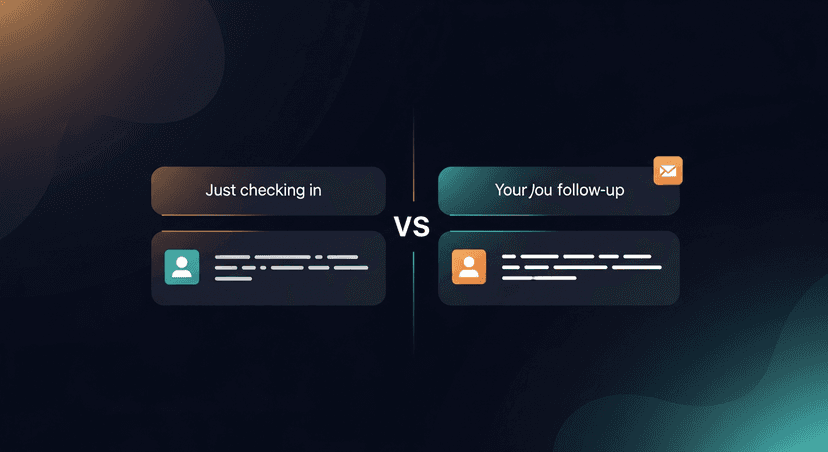
Bad: "Let me know if you have any questions!"
Good: "I have 20 minutes open Thursday at 2pm or Friday at 10am, does either work? If not, send me a time that does."
The specificity signals confidence. It also makes it easy to say yes. Friction is the enemy of urgency, every extra click, every "we'll find a time," every "I'll check with my team" is a place where momentum dies.
ReplySequence does this automatically, paste any transcript, get a branded follow-up sequence back in 60 seconds, with specific next-step language pulled from what was actually discussed in the meeting.
4. Use Social Proof Tied to Their Situation
Note: only use this if you have real proof. Don't fabricate it.
If you have a customer in a similar vertical who moved fast and got results, reference it (with permission). If you don't, use industry data:
> "Companies that implement post-meeting follow-up sequences within the first month of a new sales motion typically see response rates 3-4x higher than teams that add it later, habits form fast."
The proof doesn't have to be your proof. Industry data, analyst reports, third-party research, all of it anchors the urgency in something real.
The Follow-Up Email Structure That Works
Here's a repeatable structure for a no-pressure urgency email:
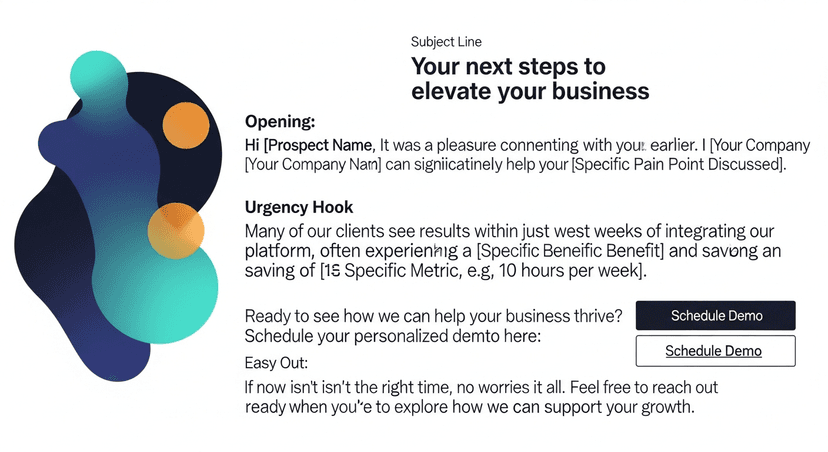
Subject line: Reference something specific from the meeting. Not "Following up", something like "Re: the Q3 onboarding window" or "The implementation timeline we discussed."
Opening line: One sentence that acknowledges where you left off. No throat-clearing.
The urgency hook: One of the four techniques above, their timeline, cost of delay, specific next step, or relevant proof. One, not all four. Pick the one that fits.
The ask: A single, specific call to action. One question. One calendar link. Not three options plus a "let me know what works."
The out: Give them an easy way to say "not now" without ghosting. Something like: "If the timing's shifted, just say the word, happy to revisit in 60 days." This feels counterintuitive, but it actually increases reply rates. You're signaling that you're not desperate, and you respect their situation.
Total length: Under 150 words. Urgency isn't verbose.
What Urgency Sounds Like Across Different Scenarios
A recruiter following up after a candidate screen:
> "Sarah mentioned she's weighing two offers and wants to decide by next Friday. If you're serious about her, this week is the window. Want me to set up the final call?"
A consultant after a scoping call:
> "You mentioned the project needs to be wrapped before your August slowdown. That's 12 weeks from now, if we start the week of May 5th, you're in good shape. After that, the timeline gets tight."
An AE after a demo:
> "Your team mentioned budget decisions get harder after June 15th when Q3 planning locks in. I can get a contract drafted this week if that's helpful."
None of these are pushy. All of them are useful. That's the distinction.
The Timing Problem
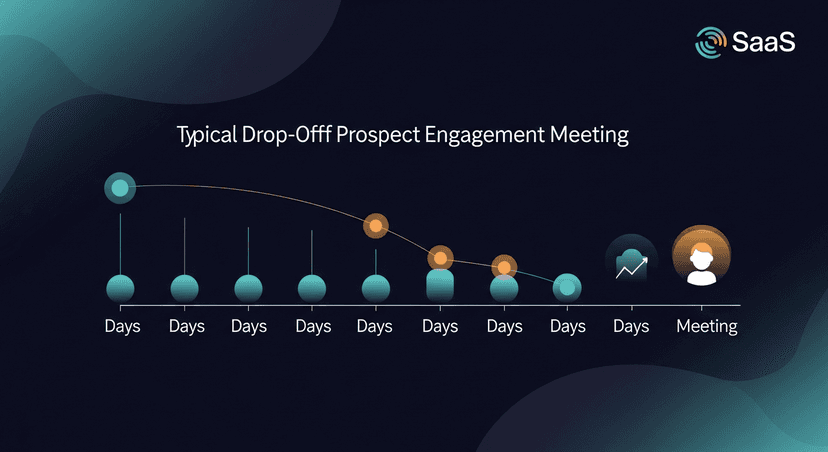
Even a perfect urgency email fails if it arrives three days after the meeting when the prospect has already moved on mentally.
Research from Lead Response Management (now widely cited by HubSpot and Salesforce) shows that responding to a lead within 5 minutes makes you 21x more likely to qualify them than responding after 30 minutes. The same principle applies to post-meeting follow-up: the sooner the follow-up lands, the higher the signal that you're organized, you listened, and you're worth doing business with.
Most reps know this. Most reps still take 24-48 hours to send a follow-up, because writing a personalized email after every call is genuinely time-consuming. The gap between knowing and doing is where deals die.
That's the gap I built ReplySequence to close, paste the transcript from Fireflies, Otter, Fathom, or wherever else, and get a follow-up sequence drafted in 60 seconds. The voice-fingerprint feature means it sounds like you wrote it, not like a template.
One More Thing: Don't Conflate Urgency With Frequency
Sending four follow-up emails in a week is not urgency. It's harassment dressed up as persistence.
Real urgency is single-signal, well-timed, and honest. It respects the prospect's intelligence. If you've sent two follow-ups with a real reason to act and heard nothing, the answer is probably no, and chasing it harder won't change that.
The reps who do this well treat the follow-up as part of the conversation, not as a separate campaign to wear the prospect down. That mindset shift (from "I need to close this" to "I'm helping them make a decision") changes everything about how the email reads.
—-
If you want to try this without the 30-minute writing tax after every call, start free at replysequence.com, 10 drafts a month, no credit card required. Paste any transcript, get a branded follow-up sequence back.
Get the weekly ReplySequence newsletter for more post-meeting follow-up tactics, subscribe at replysequence.com/newsletter.
Related reading
- Close Open Loops From Sales Calls Before They Kill Your Deal
- Post-Meeting Email Templates That Close Deals in 2026
- Re-Engage a Prospect Who Went Silent After a Meeting
—-
What you should do next…
Depending on where you're at, here are three ways to keep going:
- Grab the free playbook, "The 8-Second Follow-Up Playbook" lands in your inbox. You'll also get Close The Loop, weekly notes on post-meeting follow-up (unsubscribe anytime, no pitch).
- Try it with your own transcript, paste any meeting transcript, get a drafted follow-up in 30 seconds. No signup, no OAuth.
- Talk directly with Jimmy, 15-min intro or 30-min walkthrough. Founder-led, no sales team.
How ReplySequence handles this
ReplySequence takes any meeting transcript, paste it in from Zoom, Teams, Meet, WebEx, Fireflies, Granola, or wherever, and drafts a context-rich follow-up email in about 8 seconds. You review it, make any edits, and approve. Deal intelligence builds automatically.