Is Gong Worth the Price? Honest Breakdown
Is Gong worth the price? For most teams under 50 reps, probably not, at least not yet. Gong is genuinely impressive technology, but the pricing structure is built for enterprise, and the ROI math gets uncomfortable fast when you're running a lean operation.
Here's an honest breakdown. No affiliate angle. No "Gong is trash" hot take either. Just the numbers and the tradeoffs.
What Gong Actually Costs
Gong doesn't publish pricing publicly, which is already a yellow flag. But based on widely reported figures from G2, Vendr, and sales community discussions, the range looks like this:
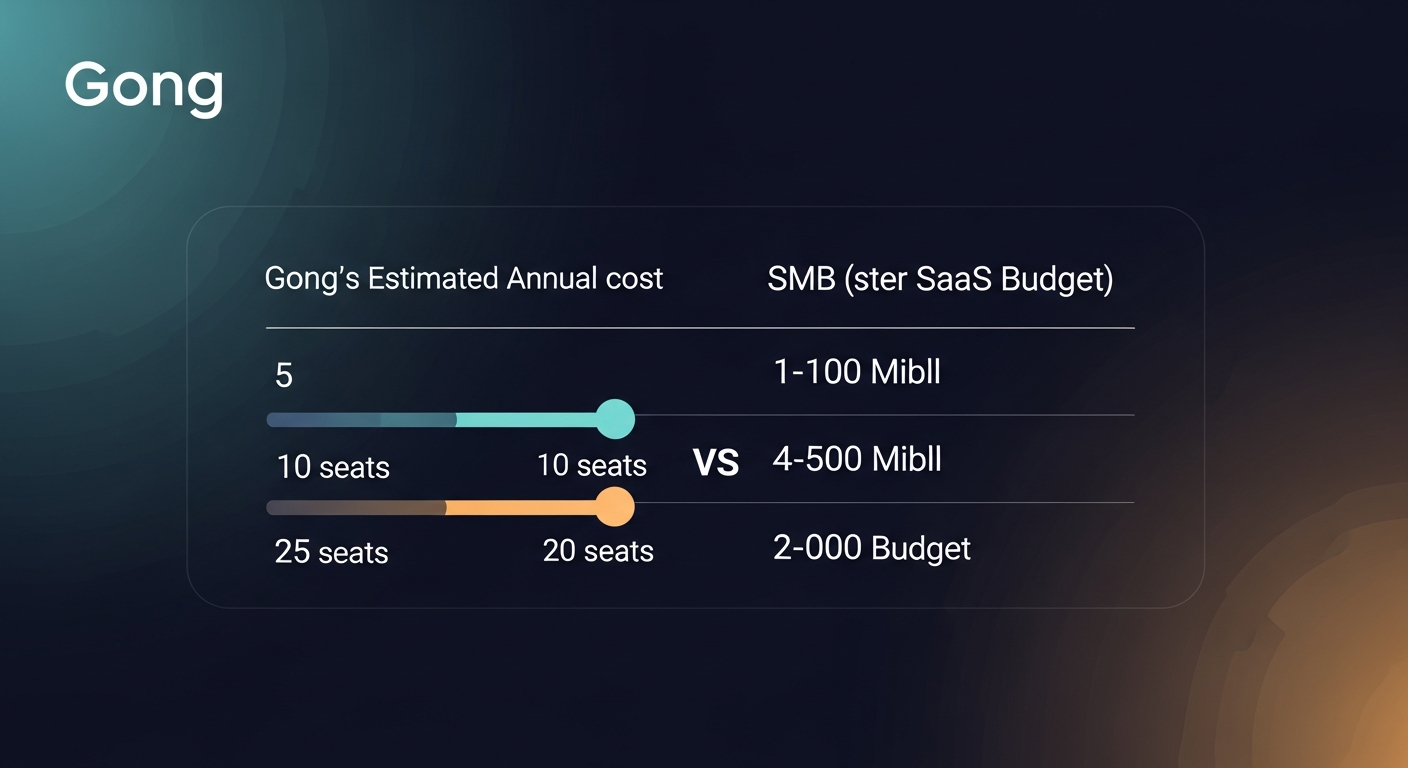
- Platform fee: ~$5,000–$7,500/year (flat, paid before a single seat)
- Per-seat cost: ~$1,200–$1,600/user/year
- Minimum contract: typically 3-seat minimum, 12-month commitment
So a team of 5 reps is looking at roughly $11,000–$15,500/year before negotiation. A team of 10 reps: $17,000–$23,500/year.
That's not a SaaS subscription: that's a line item that needs a CFO's signature.
Gong will negotiate. Renewal discounts exist. But the floor is still high, and the platform fee means you're paying just to get in the door.
What You're Paying For
To be fair: Gong does a lot. It's not just a recorder.
- Call recording and transcription across Zoom, Teams, Meet, and phone
- Conversation intelligence, talk-to-listen ratios, topic tracking, competitor mentions
- Deal intelligence, pipeline risk signals, engagement scoring
- Coaching workflows, managers can comment on specific moments in calls
- Forecast analytics, activity-based revenue projections
- CRM sync, pushes data to Salesforce, HubSpot, etc.
For a 50+ rep org with a VP of Sales who lives in pipeline reviews, that full stack is genuinely valuable. The coaching layer alone (being able to pinpoint exactly where a discovery call went sideways) is something managers in high-volume environments will use daily.
But here's the thing: most growing teams use maybe 40% of what Gong offers. The recording and transcription? Yes. The deal intelligence and forecast modeling? Rarely, until you have the data volume and the ops maturity to act on it.
ReplySequence does this automatically, paste any transcript, get a branded follow-up sequence back in 60 seconds.
The ROI Math: Where It Gets Honest
Gong's own marketing cites numbers like "20% increase in win rates" and "2x pipeline coverage." Those figures come from their commissioned research, so take them with appropriate skepticism. But even directionally, does the math work?
Let's run it for a 10-person sales team:
- Annual Gong cost: ~$20,000 (mid-range estimate)
- Average ACV per deal: $15,000 (typical mid-market SaaS)
- To break even: Gong needs to help close ~1.3 additional deals per year across the whole team
That's a low bar. If Gong's coaching tools help even one rep close one more deal, it pays for itself.
But (and this is the part that doesn't show up in vendor decks) that ROI assumes:
- Someone actually watches the call recordings
- Managers have time to run coaching workflows
- Reps act on the feedback
- The data volume is high enough for the AI insights to be meaningful
A Harvard Business Review analysis on sales coaching found that the majority of coaching time in most sales orgs is spent on administrative prep, not actual coaching conversations. Gong can reduce the prep burden, but only if the team has the operational rhythm to use it consistently.
For a 5-person team where the founder is also the sales manager? That rhythm is rarely there.
Where Gong Wins, Clearly
Enterprise sales orgs (50+ reps). The platform fee becomes negligible per seat. The coaching tools get real ROI when managers have 8–10 reps each. The forecast analytics matter when a VP of Sales is presenting to a board.
Teams with high call volume and complex sales cycles. If your reps are running 10+ discovery calls a week with 90-day sales cycles, conversation intelligence that surfaces competitor mentions and objection patterns has obvious compounding value.
Orgs with a dedicated revenue ops or enablement function. Someone needs to configure the deal stages, build the scorecard, manage the integrations. Gong without an ops owner is like buying a commercial kitchen and not hiring a chef.
Where Gong Doesn't Win
Teams under 20 reps without dedicated sales ops. The platform is feature-heavy and the onboarding is real work. You're paying for tooling that'll sit half-configured for months.
Founders or AEs running their own outreach. A solo founder doing 15 discovery calls a month doesn't need enterprise forecast modeling. They need the transcript turned into a great follow-up email before the prospect's attention evaporates.
Teams primarily using Gong as a recorder. If you're already getting transcripts from Fireflies, Otter, Fathom, or even Zoom's built-in transcription (and you're not using Gong's coaching or deal intelligence layers) you're paying $1,400+/seat for something you're getting cheaper elsewhere.
This is the gap I built ReplySequence to address. Transcription is solved. The last mile (turning that transcript into a sent, personalized follow-up) wasn't. Gong doesn't do that. Fathom doesn't do that. Fireflies has a draft feature that's generic at best. Paste your transcript, get a follow-up sequence back that sounds like you, not like GPT defaults.
Gong Alternatives Worth Considering
Depending on what you actually need:
If you want conversation intelligence without the platform fee:
- Chorus (ZoomInfo), comparable features, sometimes negotiable on price for existing ZoomInfo customers
- Salesloft Conversations, solid if you're already in the Salesloft ecosystem
- Avoma, more SMB-friendly pricing, includes meeting scheduling and notes
If you mainly need recording + transcription:
- Fathom, free tier is genuinely good, Zoom-native
- Fireflies, strong integrations, reasonable per-seat pricing
- Otter, good for async teams and mixed call environments
- Granola, lightweight, well-designed for founders and AEs who prefer local-first
If the gap is follow-up, not recording:
- That's what I built ReplySequence for. BYOT, bring your own transcript from whatever recorder you use, paste it in, get a branded follow-up sequence back. Pro starts at $29/month. No platform fee. No 12-month contract minimum.
The Verdict
Is Gong worth the price? It depends entirely on team size and how much of the platform you'll actually use.
- 50+ reps, dedicated sales ops, complex deals: Gong ROI is real. The coaching and deal intelligence layers justify the cost.
- 10–50 reps, growing fast, need structure: Maybe, but negotiate hard, start with a smaller seat count, and make sure someone owns the implementation.
- Under 10 reps, founder-led sales, or lean AE team: Almost certainly not. The platform fee alone is deadweight. Get Fathom or Fireflies for recording, and solve the follow-up problem separately.
The most expensive thing in sales isn't the tools. It's the deals that go quiet after a great meeting because the follow-up never landed. That's the problem worth solving first, and it doesn't cost $1,400 a seat.
—-
If you're looking for a lighter-weight place to start, try ReplySequence free at replysequence.com, 10 drafts a month, no credit card required. Paste a transcript from Gong, Fathom, Fireflies, or anywhere else and get a follow-up sequence back in 60 seconds.
Get the weekly ReplySequence newsletter for more honest post-meeting follow-up tactics, subscribe at replysequence.com/newsletter.
Related reading
- Best Gong Alternative for Small Sales Teams
- Why Your 10-Person Sales Team Doesn't Need a $100K Gong Contract
- Chorus by ZoomInfo Alternative: Better Options for Follow-Up
—-
What you should do next…
Depending on where you're at, here are three ways to keep going:
- Grab the free playbook, "The 8-Second Follow-Up Playbook" lands in your inbox. You'll also get Close The Loop, weekly notes on post-meeting follow-up (unsubscribe anytime, no pitch).
- Try it with your own transcript, paste any meeting transcript, get a drafted follow-up in 30 seconds. No signup, no OAuth.
- Talk directly with Jimmy, 15-min intro or 30-min walkthrough. Founder-led, no sales team.
How ReplySequence handles this
ReplySequence takes any meeting transcript, paste it in from Zoom, Teams, Meet, WebEx, Fireflies, Granola, or wherever, and drafts a context-rich follow-up email in about 8 seconds. You review it, make any edits, and approve. Deal intelligence builds automatically.